
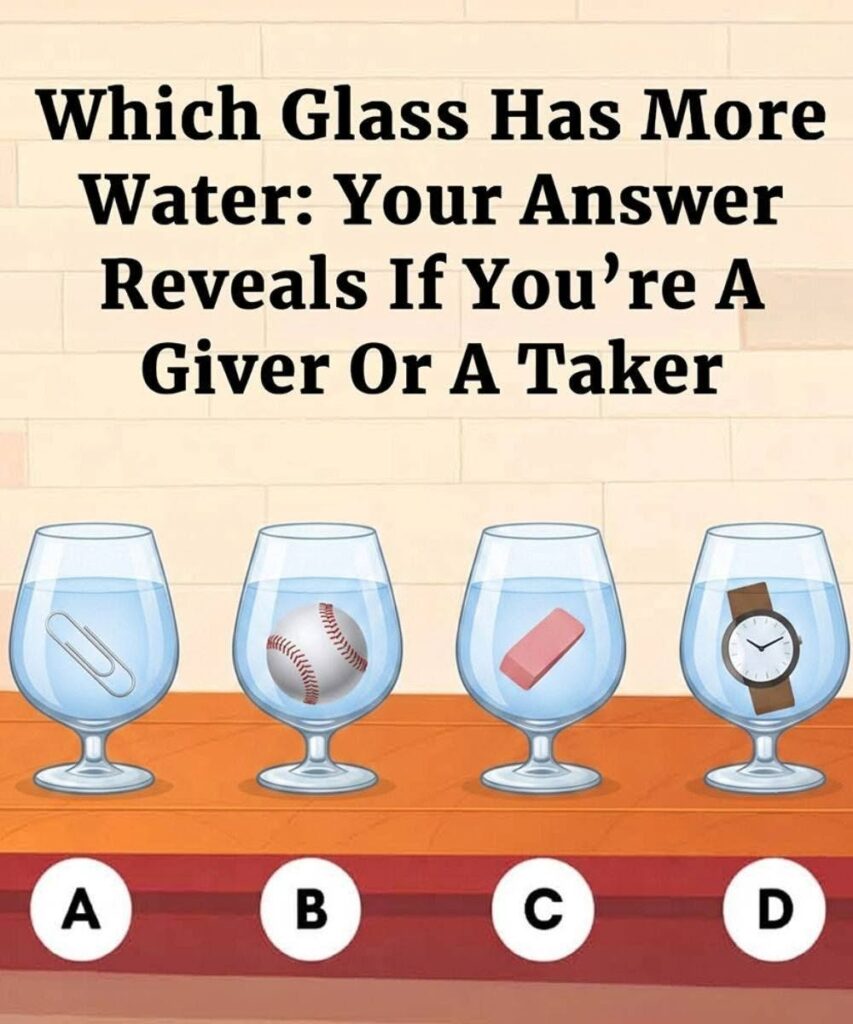
Why Many People Get It Wrong
Our brains naturally focus on what we can see.
When the water lines appear identical, we tend to assume the water amounts are identical too.
The puzzle challenges us to look beyond appearance and consider what is happening inside the glass.
🔍 What the Puzzle Really Measures
In reality, puzzles like this do not scientifically determine whether someone is a “giver” or a “taker.”
However, they can reveal something interesting about how people approach problems.
Some People Focus on Appearance
They see equal water levels and conclude:
“All the glasses contain the same amount.”
This often reflects a tendency to trust first impressions.
Some People Analyze the Details
They immediately think about:
- Volume
- Displacement
- Hidden variables
These individuals may enjoy analytical thinking and problem-solving.
Some People Follow Intuition
They choose an answer quickly based on instinct rather than calculation.
That doesn’t mean they’re wrong-it simply reflects a different thinking style.
The “Giver or Taker” Interpretation
Many versions of this puzzle include personality descriptions based on which glass someone selects.
For example:
Choosing the Smallest Object
Often interpreted as:
- Thoughtful
- Observant
- Detail-oriented
- Generous
Choosing the Largest Object
Sometimes associated with:
- Confidence
- Decisiveness
- Bold thinking
Saying “They’re All Equal”
Often linked to:
- Fairness
- Practicality
- Preference for simplicity
Choosing the Floating Object
Sometimes interpreted as:
- Creativity
- Independent thinking
- Willingness to challenge assumptions
Important note: These interpretations are entirely subjective and not supported by psychological research.
Why Personality Puzzles Feel So Accurate
Many people are surprised by how relatable these descriptions seem.
Psychologists have long studied this phenomenon.
The Barnum Effect
The Barnum Effect occurs when people see vague, broadly applicable statements as uniquely personal.
Examples include:
- “You care deeply about others.”
- “You sometimes doubt yourself.”
- “You value honesty.”
Most people identify with these traits to some degree.
As a result, personality puzzle results often feel surprisingly accurate.
Why We Love These Challenges
Visual puzzles combine several things people enjoy:
Curiosity
We want to know the answer.
Competition
We compare our responses with others.
Self-Discovery
We enjoy learning about ourselves-even through playful exercises.
Conversation
Puzzles spark discussion and debate.
That’s why they remain popular on social media and at gatherings.
The Science Behind Water Displacement
The actual puzzle relies on a fundamental principle discovered by:
Archimedes
More than 2,000 years ago, Archimedes recognized that an object submerged in a fluid displaces a volume equal to the amount of space it occupies.
This principle remains important today in:
- Engineering
- Shipbuilding
- Physics
- Fluid mechanics
A simple glass puzzle turns out to be a miniature lesson in science.
What Your Answer Really Says
If anything, your answer may reveal:
How You Process Information
Do you rely on:
- Observation?
- Analysis?
- Intuition?
How Quickly You Decide
Some people answer immediately.
Others carefully think through every possibility.
How Comfortable You Are With Ambiguity
Many people question the puzzle itself and look for missing information.
That’s a valuable thinking skill too.
A Better Question Than “Giver or Taker”
Instead of asking:
“Am I a giver or a taker?”
The puzzle may encourage a more useful question:
“How do I approach problems?”
Understanding your thinking style can be more meaningful than any personality label.
Final Thoughts
The correct answer to the glass puzzle comes down to simple physics: the glass containing the smallest object generally holds the most water because less volume has been displaced. While social media often attaches personality labels like “giver” or “taker” to different choices, these interpretations are meant for fun rather than serious psychological analysis.
What makes the puzzle so enjoyable isn’t the personality result-it’s the way it challenges our assumptions. A quick glance suggests all the glasses are equal. A closer look reveals a hidden layer of information. Sometimes the most interesting lessons come from realizing that what we see at first isn’t always the full story.

Leave a Reply