
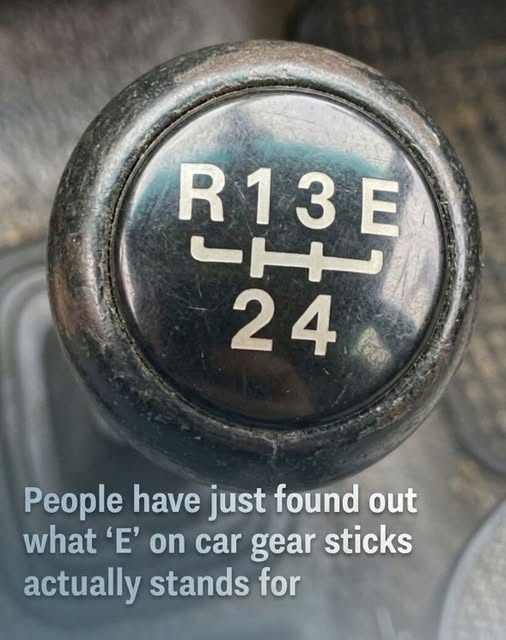
If you’ve ever climbed into an older car, truck, or vintage vehicle and noticed a mysterious letter “E” printed beside the gear positions, you’re not alone. For many modern drivers, especially those who learned to drive in vehicles filled with touchscreens, drive-mode buttons, and computer-controlled transmissions, this unusual marking can be confusing.
Social media posts and automotive forums regularly feature photos of old gear selectors with captions asking, “What does the E stand for?” The answers often range from reasonable guesses to completely incorrect theories. Some people think it means “Electric.” Others assume it stands for “Emergency.” A few even believe it refers to an engine braking system.
In reality, the answer is much simpler.
On many older vehicles, the letter E stood for Economy, a driving mode designed to improve fuel efficiency by changing how the transmission behaved. At a time when fuel prices fluctuated, emissions regulations were evolving, and automotive technology was rapidly advancing, manufacturers sought ways to help drivers save fuel without requiring major changes in driving habits.
The result was a transmission setting that prioritized efficiency over performance.
Although the concept may seem ordinary today, Economy mode represented an important step in the evolution of modern automotive technology. Understanding what it did provides an interesting glimpse into how cars have changed over the past several decades.
Why Older Cars Had Different Driving Modes
The Automotive World Was Changing
During the 1970s, 1980s, and 1990s, automakers faced increasing pressure to improve fuel economy.
Several factors contributed to this shift:
- Rising fuel costs
- Oil crises
- Environmental concerns
- Government fuel-efficiency standards
- Consumer demand for better mileage
Manufacturers began experimenting with ways to reduce fuel consumption without sacrificing convenience.
Automatic transmissions became a major focus of these efforts.
Drivers Wanted More Control
Early automatic transmissions were often less sophisticated than modern systems.
They lacked advanced computer controls and adaptive learning technologies.
As a result, manufacturers sometimes gave drivers multiple operating modes that allowed them to prioritize either:
- Fuel economy
- Performance
- Towing capability
- Winter traction
Economy mode became one of the most common options.
What Economy Mode Actually Did
Earlier Gear Shifts
One of the primary goals of Economy mode was reducing engine speed.
When Economy mode was selected, the transmission would often shift into higher gears sooner.
For example:
- First gear would shift earlier.
- Second gear would engage sooner.
- Engine RPM would remain lower.
Because the engine worked at lower speeds, fuel consumption often decreased.
Lower Engine RPM
RPM stands for revolutions per minute.
Higher RPM generally means the engine is working harder and consuming more fuel.
Economy mode attempted to keep RPM levels lower whenever possible.
This helped drivers achieve better fuel efficiency during normal driving conditions.
Reduced Throttle Response
Some Economy modes also altered throttle behavior.
The vehicle became slightly less eager to accelerate aggressively.
While this could make the car feel less sporty, it often contributed to improved fuel economy.
Many drivers barely noticed the difference during routine commuting.
How Economy Mode Felt Behind the Wheel
Smoother Driving Experience
Drivers often described Economy mode as smoother and more relaxed.
The transmission shifted sooner and avoided high engine speeds.
This created a calm driving character well suited for:
- Highway travel
- Daily commuting
- City driving
- Long-distance trips
Slower Acceleration
The tradeoff for improved efficiency was reduced responsiveness.
Compared to performance-oriented settings, Economy mode often felt:
- Less aggressive
- More deliberate
- Slightly slower when accelerating
The vehicle still functioned normally, but it prioritized fuel savings over rapid acceleration.
Better Fuel Consumption
Under favorable conditions, drivers could see measurable improvements in fuel economy.
The exact benefit depended on:
- Driving habits
- Vehicle design
- Road conditions
- Engine size
Some drivers reported only minor improvements, while others appreciated the savings over time.
The Opposite of Economy Mode
Sport Mode
Many vehicles paired Economy mode with Sport mode.
Sport mode generally did the opposite.
Instead of shifting early, it would:
- Hold gears longer
- Increase RPM
- Improve acceleration response
- Prioritize performance
Drivers seeking a more engaging driving experience often preferred Sport mode.
Power Mode
Some manufacturers used the letter P instead of S.
Power mode focused on stronger acceleration and increased responsiveness.
Compared with Economy mode, Power mode usually:
- Delayed gear shifts
- Increased engine speed
- Improved passing power
- Enhanced throttle response
The tradeoff was increased fuel consumption.
Why Multiple Modes Existed
Different driving situations require different priorities.
A driver commuting through traffic might value efficiency.
The same driver entering a highway might appreciate stronger acceleration.
Multiple transmission modes allowed vehicles to adapt to varying needs.
Why Modern Cars Rarely Use "E"
Computers Now Handle Everything
Modern transmissions are dramatically more advanced than their predecessors.
Today’s vehicles use sophisticated software capable of monitoring:
- Vehicle speed
- Throttle position
- Road conditions
- Driver behavior
- Engine load
The computer continuously adjusts shifting patterns without requiring driver intervention.
Adaptive Learning Systems
Many modern vehicles learn from driving habits.
The transmission may automatically recognize whether the driver prefers:
- Relaxed driving
- Aggressive acceleration
- Highway cruising
- Stop-and-go traffic
The vehicle then adjusts its behavior accordingly.
This makes dedicated Economy positions less necessary.
Integrated Drive Modes
Although the letter E has largely disappeared, the concept remains alive.
Modern vehicles often include drive-mode selections such as:
- Eco
- Normal
- Sport
- Comfort
- Snow
- Tow/Haul
Eco mode is essentially the modern descendant of the old Economy setting.
Common Misconceptions About the Letter "E"
Myth: It Means Electric Mode
One of the most common misunderstandings is that E stands for Electric.
In most older vehicles, this is incorrect.
Fully electric passenger vehicles were far less common when these transmissions were designed.
Economy mode is usually the intended meaning.
Myth: It Means Emergency
Some drivers assume the letter refers to an emergency gear.
This interpretation is generally inaccurate.
Vehicle manufacturers did not typically designate emergency driving modes with the letter E.
Myth: It Means Engine Brake
Certain heavy vehicles and commercial trucks use engine braking systems.
However, the E on many passenger-car transmissions does not refer to engine braking.
Instead, it usually indicates Economy mode.
Always Check the Owner’s Manual
While Economy is the most common meaning, exact definitions can vary slightly between manufacturers.
Consulting the owner’s manual remains the best way to confirm a specific vehicle’s design.
The Evolution of Transmission Technology
Early Automatic Transmissions
The first automatic transmissions were mechanical marvels but lacked today’s computing power.
Drivers often had to manually select settings based on driving conditions.
Electronic Controls Changed Everything
The introduction of electronic transmission controls revolutionized vehicle operation.
Computers could make adjustments faster and more accurately than human drivers.
This improved:
- Fuel economy
- Performance
- Reliability
- Comfort
Today’s Smart Systems
Modern transmissions can contain:
- Multiple sensors
- Adaptive algorithms
- Real-time diagnostics
- Predictive shifting logic
Many decisions once handled by the driver now occur automatically.
Other Vintage Car Features Younger Drivers Rarely See
Manual Choke Controls
Older carbureted engines often required drivers to operate a choke manually during cold starts.
Many younger drivers have never encountered this feature.
Pop-Up Headlights
Once common on sports cars, pop-up headlights became iconic automotive design elements before largely disappearing.
Bench Seats
Many older cars featured full-width front bench seats rather than individual bucket seats.
Vent Windows
Small triangular windows near the front doors allowed airflow before air conditioning became widespread.
Column Shifters
Instead of a center-console gear selector, many vehicles placed the shifter on the steering column.
These features remind us how dramatically automotive design has evolved.
Why People Are Rediscovering Old Gear Shift Markings
Social Media Curiosity
Vintage vehicle photographs frequently circulate online.
When younger audiences encounter unfamiliar controls, curiosity naturally follows.
The mysterious E has become one of the most frequently discussed examples.
Cars Have Changed Rapidly
The pace of automotive innovation has accelerated dramatically.
Features considered ordinary thirty years ago may appear strange today.
Nostalgia Drives Interest
For older drivers, seeing an Economy mode selector often sparks memories of earlier vehicles and road trips.
For younger drivers, it provides a fascinating glimpse into automotive history.
Frequently Asked Questions
What does E stand for on older gear selectors?
In most cases, E stands for Economy, a mode designed to improve fuel efficiency.
Did Economy mode save fuel?
Often yes. By encouraging earlier gear shifts and lower engine RPM, it could improve fuel economy under many driving conditions.
Is Economy mode the same as Eco mode?
Essentially yes. Modern Eco modes serve a similar purpose using more advanced technology.
Why don’t new cars use E anymore?
Modern computer-controlled transmissions automatically manage efficiency, reducing the need for a separate Economy position.
Could Economy mode damage the engine?
No. Economy mode was designed by manufacturers as a normal operating setting and posed no harm when used appropriately.
Final Thoughts
The mysterious letter “E” on older car gear shifts is far less mysterious than many people imagine. In most vehicles, it simply stood for Economy-a transmission mode designed to prioritize fuel efficiency by encouraging earlier shifts and lower engine speeds.
At the time, this feature represented a practical solution to growing concerns about fuel consumption and operating costs. While modern vehicles achieve similar goals through sophisticated software and adaptive transmission controls, the underlying idea remains remarkably familiar.
Today’s Eco modes, intelligent transmissions, and fuel-saving technologies all trace part of their heritage back to these earlier systems. What once appeared as a simple letter on a gear selector was actually an early attempt to give drivers more control over efficiency.
As automotive technology continues to evolve, features like the Economy setting offer a fascinating reminder that many modern innovations began with surprisingly simple ideas.
Sometimes a single letter on an old gear shift tells a much bigger story about how cars-and the people who drive them-have changed over time.


Leave a Reply