
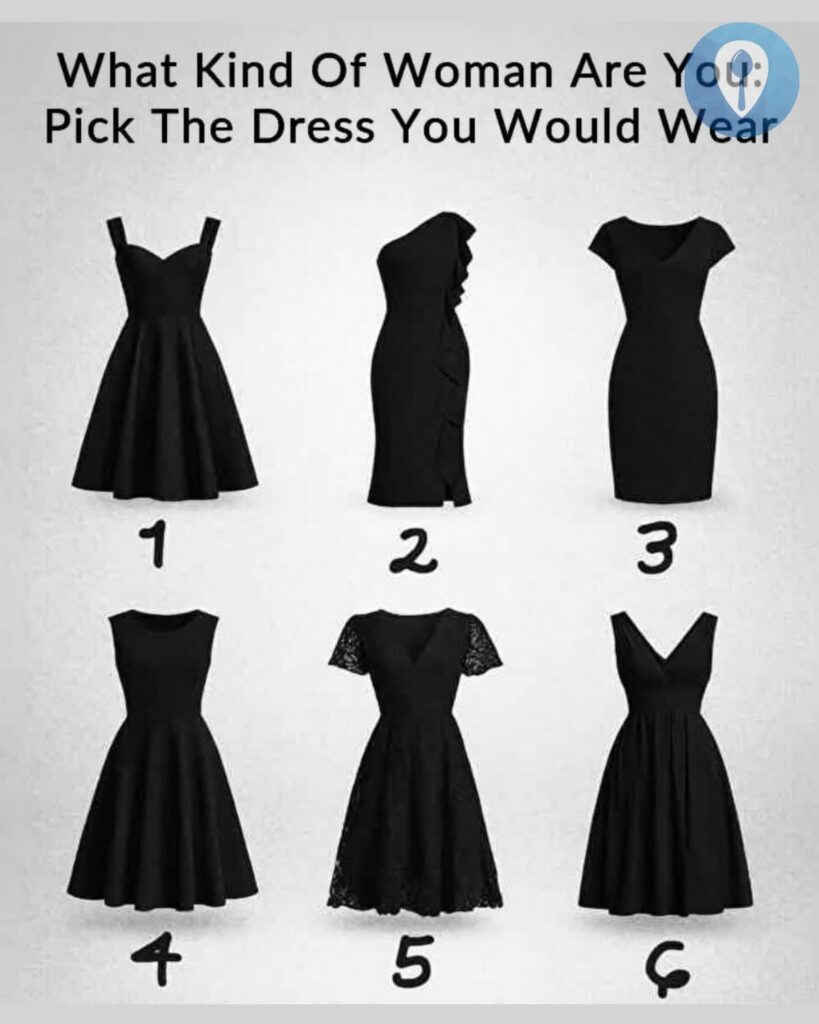
Scroll through social media for a few minutes and chances are you’ll encounter one of those irresistible personality quizzes. The image usually displays several dresses in different colors and styles alongside a simple question:
“Choose a dress and discover what kind of woman you are.”
Within hours, thousands of comments appear.
Some people choose the elegant black dress.
Others prefer the bright red one.
Many are surprised when the results seem strangely accurate.
“You are independent but caring.”
“You love adventure but value stability.”
“You are confident, creative, and deeply loyal.”
The descriptions often feel personal and insightful. Sometimes they seem so accurate that people wonder whether a simple fashion choice can truly reveal hidden aspects of their personality.
The reality is far less mysterious-but equally fascinating.
While dress-choice personality quizzes can be entertaining, they are not scientifically valid personality assessments. Instead, they reveal something much simpler: your current preferences, aesthetic tastes, cultural influences, and momentary feelings.
Understanding why these quizzes feel so accurate can teach us something interesting about both psychology and human nature.
Why Dress-Choice Quizzes Are So Popular
Humans naturally enjoy learning about themselves.
From ancient astrology to modern personality assessments, people have always searched for ways to understand their identity.
Dress-choice quizzes combine two things many people already enjoy:
- Fashion
- Self-discovery
The format is simple.
You look at several dresses.
You choose the one you like best.
You receive a personality description.
The process takes less than a minute, yet it feels surprisingly personal.
That simplicity explains much of the appeal.
Unlike lengthy questionnaires or psychological assessments, these quizzes provide instant results with minimal effort.
What Your Dress Choice Actually Reveals
When you choose a dress from a collection of images, your decision is usually influenced by factors such as:
- Favorite colors
- Fashion preferences
- Current mood
- Lifestyle
- Cultural influences
- Personal experiences
- Trends you enjoy
For example, someone might choose a simple black dress because they appreciate timeless fashion.
Another person may choose a bright floral dress because they enjoy cheerful colors.
A third person may prefer a sleek modern design because it aligns with their personal style.
These choices certainly reveal preferences.
However, preferences are not the same thing as personality traits.
Liking a red dress does not automatically mean someone is bold.
Choosing a blue dress does not prove someone is calm.
Selecting an elegant dress does not confirm sophistication.
The connection is far more complicated than these quizzes suggest.
The Psychology Behind Fashion Preferences
Although dress choices do not reveal hidden personality secrets, clothing preferences can provide insight into certain aspects of behavior and self-expression.
Researchers have found that people often use clothing to communicate:
- Identity
- Social belonging
- Creativity
- Professionalism
- Personal values
Fashion functions as a form of nonverbal communication.
The clothes we wear can influence how others perceive us and how we perceive ourselves.
Someone who enjoys minimalist styles may appreciate simplicity and practicality.
Someone who enjoys bold patterns may enjoy visual stimulation and self-expression.
However, even these observations are tendencies rather than fixed psychological truths.
A person’s clothing preferences can change dramatically depending on:
- Age
- Occupation
- Environment
- Life stage
- Mood
- Occasion
This flexibility makes it impossible to accurately define personality based on a single fashion choice.
Why The Results Often Feel Accurate
One of the most fascinating aspects of these quizzes is how often participants feel the results describe them perfectly.
Psychologists have studied this phenomenon for decades.
The explanation is known as the Barnum Effect.
Understanding the Barnum Effect
The Barnum Effect occurs when people accept vague, general statements as highly personal descriptions.
For example:
“You sometimes doubt yourself even though others see you as confident.”
“You care deeply about people but occasionally need time alone.”
“You have great potential that you do not always fully utilize.”
Most people can relate to these statements.
They contain a mixture of positive qualities and common human experiences.
Because the descriptions feel personal, individuals often assume they were specifically written for them.
In reality, they could apply to millions of people.
Dress-choice quizzes frequently rely on this psychological principle.
The results are carefully written to sound insightful while remaining broad enough to fit a wide audience.
Why Humans Love Personality Labels
Another reason these quizzes remain popular is that humans naturally enjoy categorization.
Labels simplify complexity.
It feels satisfying to hear:
- “You are a leader.”
- “You are a free spirit.”
- “You are an old soul.”
- “You are an adventurer.”
These labels provide an easy framework for understanding ourselves.
The problem is that real personalities are much more complex.
Most people display different traits in different situations.
Someone may be:
- Confident at work
- Shy at parties
- Adventurous when traveling
- Cautious with finances
- Outgoing with friends
- Reserved with strangers
Human behavior changes depending on context.
No single dress choice can capture that complexity.
Can Clothing Reflect Personality at All?
The answer is yes-but only to a limited extent.
Research suggests there can be relationships between certain clothing preferences and broader behavioral tendencies.
For example:
People who prefer practical clothing may value comfort.
People who enjoy experimenting with fashion may score higher in creativity.
People who pay close attention to appearance may place greater importance on self-presentation.
However, these are tendencies rather than rules.
Two people can choose the exact same dress for completely different reasons.
One may love the color.
Another may appreciate the fit.
A third may simply like how it reminds them of a favorite memory.
The visual choice alone cannot reveal the underlying motivation.
The Influence of Mood
One major flaw in dress-choice personality quizzes is that they ignore temporary emotional states.
Mood significantly influences preferences.
A person who chooses a bright yellow dress today may select a black dress tomorrow.
Neither choice necessarily indicates a change in personality.
Instead, the difference may reflect:
- Energy level
- Weather
- Recent experiences
- Current emotions
- Upcoming events
This variability demonstrates why personality cannot be accurately measured through a single visual preference.
The Difference Between Style and Personality
Style and personality overlap, but they are not identical.
Style refers to preferences.
Personality refers to enduring patterns of thought, emotion, and behavior.
Someone may enjoy glamorous clothing without being outgoing.
Someone may prefer simple clothing while possessing a highly creative personality.
Someone may wear bold colors yet remain introverted.
Fashion expresses only one small aspect of identity.
Reducing a person to a single style choice oversimplifies who they are.
What Scientific Personality Assessments Measure
Legitimate personality assessments typically evaluate characteristics such as:
- Openness to experience
- Conscientiousness
- Extraversion
- Agreeableness
- Emotional stability
These traits are measured using carefully validated questionnaires involving numerous questions.
Researchers analyze patterns across multiple responses rather than relying on one isolated choice.
Even then, personality assessment remains an imperfect science.
Compared to these methods, dress-choice quizzes function primarily as entertainment.
Why Sharing Quiz Results Feels Fun
Despite their lack of scientific validity, these quizzes provide genuine enjoyment.
They encourage:
- Conversation
- Self-reflection
- Social interaction
- Friendly comparison
- Curiosity
Friends enjoy comparing results.
Families discuss different choices.
Comment sections become filled with stories and opinions.
The social experience often matters more than the accuracy of the outcome.
How Social Media Amplifies Their Popularity
Modern platforms are perfectly designed for this type of content.
The formula is simple:
- Present attractive images.
- Ask users to make a choice.
- Offer an intriguing interpretation.
- Encourage sharing.
Because participation requires almost no effort, engagement remains extremely high.
People enjoy feeling included in a collective experience.
This is why dress-choice quizzes continue appearing year after year.
A Healthier Way to View These Quizzes
Rather than asking:
“What kind of person am I?”
It may be more useful to ask:
“What does this choice say about what I like right now?”
This approach acknowledges that preferences are meaningful without treating them as psychological diagnoses.
A dress choice may reveal:
- Current aesthetic tastes
- Fashion interests
- Preferred colors
- Lifestyle preferences
These observations can be interesting while remaining realistic.
Frequently Asked Questions
Do dress-choice quizzes reveal personality?
Not in a scientific sense. They primarily reflect preferences and aesthetic choices.
Why do the results feel so accurate?
Many quizzes use broad statements that rely on the Barnum Effect.
Can fashion reflect personality?
Sometimes, but the relationship is complex and cannot be determined from a single choice.
Are these quizzes psychological tests?
No. They are entertainment rather than validated psychological assessments.
Is there any harm in taking them?
Generally no. They can be fun as long as people understand they are not scientific evaluations.
Final Thoughts
Dress-choice personality quizzes remain popular because they combine fashion, curiosity, and self-reflection in a simple and engaging format. Choosing a favorite dress can reveal something about your style preferences, visual tastes, and current mood. What it cannot do is accurately define your character, intelligence, relationships, or emotional depth.
The reason these quizzes feel meaningful has less to do with hidden psychological insight and more to do with how the human mind interprets information. Broad personality descriptions often feel personal because they reflect experiences shared by many people.
That does not make these quizzes worthless. They can still be enjoyable conversation starters and entertaining ways to explore personal preferences.
The key is remembering what they truly are.
They are not windows into your deepest personality.
They are reflections of your taste.
And while style may express part of who you are, it can never tell the whole story.


Leave a Reply