
Not Everyone Has One
Unlike many muscles that are present in nearly every person, the palmaris longus is highly variable.
Some people have:
- One tendon
- Two tendons
- No tendon at all
All of these variations are considered normal.
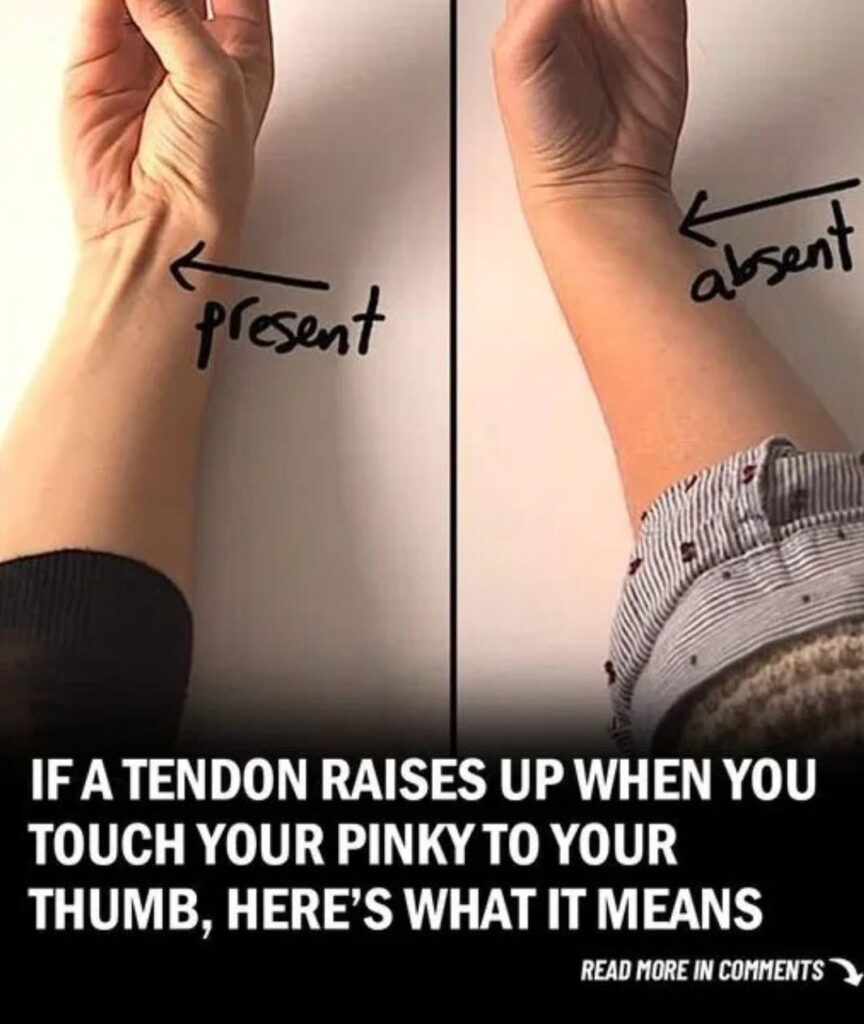
How to Check Whether You Have It
The most common test is simple.
Step 1
Hold your arm out with your palm facing upward.
Step 2
Touch your thumb to your little finger.
Step 3
Slightly flex your wrist.
If present, a narrow tendon often becomes visible in the center of the wrist.
What If You Don’t See Anything?
You may simply lack the palmaris longus tendon.
This is completely normal.
Alternatively, the tendon may be present but difficult to see because of individual anatomy, body composition, or tendon positioning.
Does the Palmaris Longus Have an Important Function?
Surprisingly, not really.
Minimal Functional Role
Researchers have found that people born without the palmaris longus generally experience:
- Normal grip strength
- Normal wrist movement
- Normal finger dexterity
- Normal athletic performance
The absence of the tendon does not appear to impair everyday activities.
What Studies Show
Comparisons between individuals with and without the tendon reveal little to no meaningful difference in hand function.
This makes the palmaris longus one of the best examples of a structure that has become largely unnecessary in modern humans.
A Window Into Human Evolution
The palmaris longus is often described as a vestigial structure.
What Does “Vestigial” Mean?
A vestigial structure is a body part that:
- Served an important purpose in ancestral species
- Has become less important over time
- Persists despite reduced functionality
Other commonly cited examples include:
- Wisdom teeth
- The tailbone (coccyx)
- Goosebumps
The palmaris longus belongs in this category.
Why Our Ancestors Needed It
Many primates spend large amounts of time climbing and swinging through trees.
Strong wrist flexion and gripping ability were essential for survival.
The palmaris longus likely contributed more significantly to these activities in our distant ancestors.
As humans evolved and adopted different lifestyles, reliance on this muscle decreased.
Today, its role is largely redundant.
Why Some People Have It and Others Don’t
Scientists believe genetics plays the primary role.
A Normal Human Variation
Just as people differ in:
- Eye color
- Height
- Hair texture
they also differ in the presence of certain muscles and tendons.
The absence of the palmaris longus is simply one example of natural anatomical diversity.
Differences Around the World
Studies have found that the frequency of missing palmaris longus tendons varies among populations.
In some groups, absence rates are relatively low.
In others, the tendon is missing much more frequently.
These differences reflect genetic variation rather than health concerns.
Why Surgeons Love the Palmaris Longus
Ironically, the tendon may be more valuable to surgeons than to the people who possess it.
A Convenient Spare Part
Because removing the tendon rarely affects hand function, surgeons often use it in reconstructive procedures.
Common Uses Include
- Tendon repair
- Ligament reconstruction
- Hand surgery
- Plastic surgery procedures
The tendon can be harvested and transplanted to another location where stronger support is needed.
Why It’s Ideal
The palmaris longus offers:
- Adequate length
- Easy accessibility
- Minimal functional consequences when removed
This makes it a useful surgical resource.
Other Muscles Humans Can Live Without
The palmaris longus is not unique.
The human body contains several structures that vary among individuals.
Examples Include
Plantaris Muscle
Located in the leg, the plantaris is absent in some people without affecting movement.
Pyramidalis Muscle
This small abdominal muscle is missing in many individuals.
Wisdom Teeth
Many people naturally lack one or more wisdom teeth.
These examples highlight how human anatomy continues to evolve and vary.
Does Missing the Tendon Affect Sports Performance?
For most athletes, the answer is no.
Research Findings
Studies evaluating:
- Grip strength
- Pinch strength
- Wrist performance
generally find little difference between individuals with and without the tendon.
Everyday Activities Remain Unchanged
Whether you’re:
- Typing
- Playing sports
- Lifting weights
- Playing musical instruments
the absence of the palmaris longus is unlikely to affect performance.
Common Myths About the Wrist Tendon
Myth #1: Missing It Means Something Is Wrong
False.
Millions of healthy people lack the tendon entirely.
Myth #2: Having It Means You’re Stronger
Research does not support this claim.
The tendon contributes little to overall hand strength.
Myth #3: It Predicts Athletic Ability
No evidence suggests the palmaris longus determines athletic success.
Performance depends on many other factors.
Myth #4: It Indicates Evolutionary “Advancement”
Some people jokingly claim that lacking the tendon makes them more evolved.
Evolution doesn’t work that way.
Both versions are normal variations within the human population.
Fascinating Facts About the Palmaris Longus
It May Be Missing on Only One Side
Some individuals have the tendon in one arm but not the other.
It Can Vary in Shape
The muscle and tendon may differ significantly from person to person.
Most People Never Notice It
Many individuals discover the tendon only after seeing online challenges or anatomy demonstrations.
Doctors Often Check for It Before Surgery
Its presence can influence surgical planning when tendon grafts are needed.
What This Tiny Tendon Teaches Us
The palmaris longus serves as a reminder that human anatomy isn’t identical from person to person.
Variation Is Normal
The human body contains countless small differences that have no impact on health.
Evolution Leaves Clues
Structures like the palmaris longus provide insight into our evolutionary history and how our bodies have changed over time.
Not Every Body Part Needs a Purpose
Sometimes evolution leaves behind remnants of the past, and the palmaris longus is one of the clearest examples.
The Bottom Line
If you can see a tendon appear in the center of your wrist when touching your thumb to your little finger, you likely have a palmaris longus tendon. If you don’t, you’re among the millions of people who naturally lack it.
This tendon is considered a vestigial structure-a leftover from our evolutionary past that serves little essential function today. Whether it’s present, absent, or only visible on one side, it has virtually no effect on grip strength, dexterity, or overall hand performance.
Far from being a medical concern, the palmaris longus is a fascinating example of how human bodies vary and how evolution leaves subtle traces of our ancestral history hidden in plain sight.



Leave a Reply