
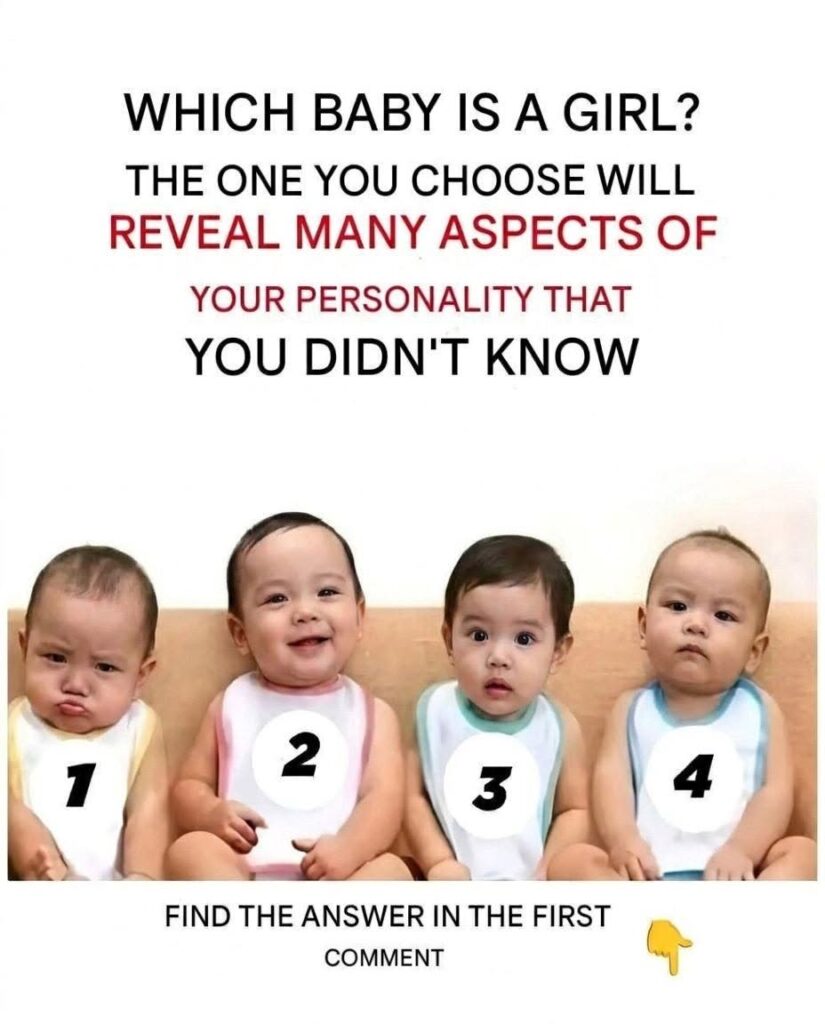
The Role of Gender Stereotypes
The quiz works because it taps into assumptions many people don’t even realize they have.
Consider these common beliefs:
| Assumption | Reality |
|---|---|
| Girls smile more | Babies of all genders smile frequently |
| Boys look tougher | Infant expressions vary individually |
| Delicate features indicate girls | Facial features differ widely among all babies |
| Certain colors signal gender | Color associations are cultural traditions |
| Hair style reveals gender | Hairstyles are chosen by caregivers |
Most people aren’t consciously trying to stereotype.
Instead, they’re relying on mental shortcuts that help the brain process information quickly.
What the Quiz Actually Measures
Contrary to popular claims, the quiz does not reveal personality traits, intelligence, intuition, or emotional insight.
Instead, it often reveals:
Personal Associations
Your choice may reflect experiences from your own life.
For example:
- Family members
- Childhood memories
- Parenting experiences
- Cultural influences
A baby who resembles a younger sibling or relative may seem more likely to fit a certain category.
Visual Attention
Different people notice different details.
Some focus on:
- Eyes
- Facial expression
- Clothing
- Body language
- Overall appearance
The feature that catches your attention first may influence your decision.
Cognitive Biases
Everyone relies on cognitive shortcuts.
These mental tools help us make quick decisions, but they can also lead to assumptions that aren’t supported by evidence.
The quiz highlights how easily those shortcuts appear in everyday situations.
Why Viral Quizzes Are So Popular
Social media users love quizzes for several reasons.
They Create Curiosity
People naturally want to know whether they guessed correctly.
They Encourage Participation
Unlike complex discussions, a simple choice requires very little effort.
They Feel Personal
Even when results are not scientifically meaningful, people enjoy learning something about themselves.
They Spark Conversation
Friends often compare answers and discuss why they chose a particular option.
This social interaction helps content spread rapidly online.
The Science of First Impressions
The popularity of these quizzes also reflects a broader psychological phenomenon.
Research suggests that people form impressions remarkably quickly.
In fractions of a second, we may unconsciously evaluate:
- Trustworthiness
- Friendliness
- Confidence
- Approachability
While these judgments can sometimes be useful, they are not always accurate.
The baby quiz reminds us how readily we assign meaning to limited information.
A Lesson in Human Perception
Perhaps the most interesting aspect of the quiz is not whether anyone identifies the “correct” answer.
It’s what happens during the process.
As we examine each face, our brains begin creating stories.
We imagine personalities.
We infer characteristics.
We make assumptions.
All from a single photograph.
This tendency reflects a deeply human desire to understand the world around us.
Why the Answer Doesn’t Matter as Much as You Think
The truth is that most infant photographs provide few reliable clues about gender.
Babies share many physical traits regardless of sex.
Without external information, accurate identification is often little more than chance.
That doesn’t make the quiz meaningless.
Instead, it shifts its value.
Rather than testing our ability to identify gender, it offers insight into how perception works.
What We Can Learn From It
The next time you encounter a viral quiz like this, consider what your answer may reveal:
- Which details drew your attention?
- What assumptions influenced your choice?
- How quickly did you decide?
- What experiences may have shaped your perception?
These questions are often more interesting than the answer itself.
Final Thoughts
The “Which Baby Is a Girl?” quiz may appear to be a simple social media game, but it offers a fascinating glimpse into human perception, pattern recognition, and cognitive bias.
While infant gender cannot reliably be determined from facial expressions or appearance alone, the exercise reveals how naturally people search for clues and construct meaning from limited information.
In the end, the real lesson isn’t about identifying a baby’s gender. It’s about understanding how our minds work-and appreciating the remarkable ways we interpret the world around us every day.

Leave a Reply