
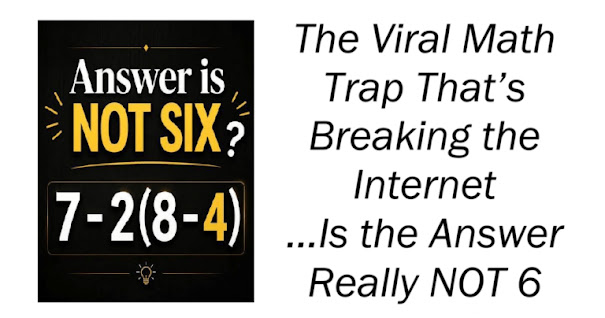
Every few months, a simple math problem takes over social media. The equation looks harmless enough. Most people glance at it, do a quick calculation in their heads, and confidently post an answer.
Then the arguments begin.
Friends disagree. Comment sections explode. Some people insist the answer is 20. Others argue for 6. A few confidently defend completely different numbers. Before long, thousands of comments appear beneath a problem that looks like it belongs in an elementary school workbook.
The latest viral debate centers around one deceptively simple expression:
7 – 2(8 – 4) = ?
At first glance, it seems too easy to cause controversy. Yet millions of people continue to disagree whenever similar problems appear online.
So why does this happen?
The answer lies in how our brains process information, how mathematical rules work, and why social media loves turning straightforward concepts into viral debates.
Let’s break down exactly what happens when you solve this expression correctly and explore why so many people fall into the trap.
The Correct Answer
Using standard mathematical conventions, the correct answer is:
-1
While some people are surprised by this result, the solution becomes obvious once you follow the established order of operations.
Step 1: Solve the Parentheses
The expression inside the parentheses comes first.
8 – 4 = 4
The equation now becomes:
7 – 2(4)
Step 2: Perform Multiplication
The expression 2(4) means exactly the same thing as:
2 × 4
So:
2 × 4 = 8
Now the equation becomes:
7 – 8
Step 3: Complete the Subtraction
7 – 8 = -1
Final answer:
-1
Under modern mathematical conventions, there is no ambiguity in this expression.
Why So Many People Get It Wrong
The fascinating part is not the answer itself.
The fascinating part is why so many intelligent people arrive at different answers.
The most common mistake comes from something psychologists call left-to-right processing bias.
Humans naturally read information from left to right. When people see:
7 – 2(4)
their brains often want to immediately subtract 2 from 7.
That shortcut feels natural because it mirrors how we read ordinary text.
Unfortunately, mathematics does not operate like a sentence.
Math follows a specific hierarchy of operations that must be respected regardless of how the expression appears on the page.
As soon as someone performs:
7 – 2 = 5
they have already broken the rules of mathematical order.
Everything afterward becomes incorrect.
Understanding PEMDAS and BODMAS
Most students learn a version of the order of operations in school.
In the United States, this is often taught as:
PEMDAS
- Parentheses
- Exponents
- Multiplication
- Division
- Addition
- Subtraction
In many other countries, students learn:
BODMAS
- Brackets
- Orders
- Division
- Multiplication
- Addition
- Subtraction
Both systems describe the same basic principle.
Certain operations must happen before others.
Many people memorize these acronyms but forget an important detail:
Multiplication and division share the same level of priority.
Addition and subtraction share the same level of priority.
This means that after parentheses and exponents are handled, multiplication and division are performed from left to right.
Likewise, addition and subtraction are completed from left to right.
This structure ensures that mathematical expressions produce consistent answers worldwide.
The Confusion Around Implied Multiplication
One reason these problems generate debate is the notation:
2(4)
Some people mistakenly believe implied multiplication should receive special treatment.
In other words, they think:
2(4)
has a different priority than:
2 × 4
Under modern mathematical conventions, it does not.
Both expressions represent multiplication.
Both are evaluated before addition or subtraction.
This is why:
7 – 2(4)
becomes:
7 – 8
and ultimately:
-1
The notation may look different, but the mathematical meaning remains the same.
Why Viral Math Problems Are Designed to Confuse You
Social media creators understand something important about human psychology.
People love being right.
Even more importantly, people love proving others wrong.
A math puzzle that creates disagreement naturally generates:
- Comments
- Shares
- Reactions
- Arguments
- Engagement
Every disagreement pushes the post into more feeds.
As a result, creators often choose expressions that exploit common mental shortcuts.
The equation appears simple enough that everyone feels confident.
Yet it contains just enough complexity to trigger mistakes.
This combination creates the perfect recipe for viral content.
The Most Common Wrong Answers
Answer: 20
This is often the result of ignoring the order of operations.
People calculate:
7 – 2 = 5
Then:
5 × 4 = 20
The mistake occurs immediately when subtraction is performed before multiplication.
Answer: 6
This answer typically appears when someone misreads the expression or confuses it with another viral problem.
In some cases, people mentally replace multiplication with addition or accidentally skip a step.
Answer: 1
This result often comes from performing operations in the wrong sequence after correctly solving the parentheses.
Although the arithmetic itself may be accurate, the order of operations has been violated.
Why Even Smart People Make These Mistakes
One of the biggest myths surrounding viral math puzzles is that getting the answer wrong means someone is bad at math.
That simply isn’t true.
In reality, these puzzles test attention more than intelligence.
Many highly educated people answer incorrectly because they:
- Rush through the problem
- Rely on intuition
- Skip written steps
- Trust mental shortcuts
Meanwhile, someone with only basic math knowledge may answer correctly simply because they carefully follow the rules.
The puzzle is less about mathematical ability and more about resisting cognitive shortcuts.
How Calculators Can Add to the Confusion
Another reason these debates persist involves calculators.
Not all calculators process expressions the same way.
Basic calculators often perform operations sequentially as they are entered.
Scientific calculators typically apply standard mathematical precedence rules automatically.
As a result, entering the same expression into different devices can occasionally produce confusion if the user is unaware of how the calculator interprets input.
Modern scientific calculators, graphing calculators, spreadsheets, and mathematical software generally follow accepted operator precedence and return:
-1
Why Order of Operations Matters in Real Life
Some people dismiss these puzzles as meaningless internet games.
However, the underlying principle is extremely important.
Order of operations appears in:
- Engineering calculations
- Computer programming
- Physics equations
- Financial models
- Construction projects
- Data analysis
A small misunderstanding in operation order can produce dramatically different outcomes.
Imagine a bridge engineer misinterpreting an equation.
Imagine a financial analyst using incorrect calculation order in a budgeting model.
Imagine a software program executing operations in the wrong sequence.
The consequences would be far more serious than a social media argument.
Mathematical conventions exist precisely because everyone must interpret expressions consistently.
Why Our Brains Prefer Shortcuts
The human brain constantly seeks efficiency.
Rather than analyzing every detail from scratch, it creates shortcuts.
These shortcuts help us:
- Read quickly
- Make decisions
- Recognize patterns
- Navigate daily life
Most of the time, shortcuts are useful.
However, they occasionally produce errors.
The expression:
7 – 2(8 – 4)
exploits one of those vulnerabilities.
Our brains see the subtraction sign and immediately want to act on it.
The order of operations forces us to pause and override that instinct.
This is why the puzzle feels harder than it actually is.
How to Avoid Falling for Similar Math Traps
The best strategy is surprisingly simple.
Slow down.
When you encounter a mixed-operation expression:
- Identify parentheses first.
- Solve exponents if present.
- Perform multiplication and division.
- Complete addition and subtraction.
Writing out each step dramatically reduces mistakes.
For example:
7 – 2(8 – 4)
7 – 2(4)
7 – 8
-1
The moment the problem is broken into stages, the confusion disappears.
Why These Puzzles Never Go Away
Viral math puzzles have existed for decades.
Long before social media, newspapers and magazines published similar challenges.
Today, the internet simply allows them to spread faster.
They continue to succeed because they combine:
- Simplicity
- Familiarity
- Confidence
- Surprise
- Competition
Everyone thinks they know the answer.
Then disagreement creates engagement.
That formula guarantees attention.
Frequently Asked Questions
Is -1 really the correct answer?
Yes. Under standard mathematical conventions and order-of-operations rules, the answer is -1.
Does implied multiplication have higher priority?
No. In modern mathematics, implied multiplication carries the same priority as explicit multiplication.
Why do people argue for 20?
They typically perform subtraction before multiplication, violating the order of operations.
Are these puzzles IQ tests?
No. They primarily test attention to detail and willingness to follow established rules.
Why do similar equations keep going viral?
Because they create disagreement, and disagreement drives engagement on social media platforms.
Final Thoughts
The viral equation 7 – 2(8 – 4) is not really a test of advanced mathematics. It is a test of patience and attention.
When solved correctly, the expression follows a straightforward sequence:
Parentheses first.
Multiplication second.
Subtraction last.
The result is:
-1
The reason millions of people continue debating problems like this has less to do with math and more to do with human psychology. We naturally trust our instincts, move quickly, and look for shortcuts.
Sometimes those shortcuts work.
Sometimes they lead us directly into a viral math trap.
The next time an equation starts a social media war, take a moment to slow down, write out the steps, and let the rules guide you. In mathematics, consistency matters more than confidence.
And when everyone follows the same rules, the answer becomes clear.



Leave a Reply