
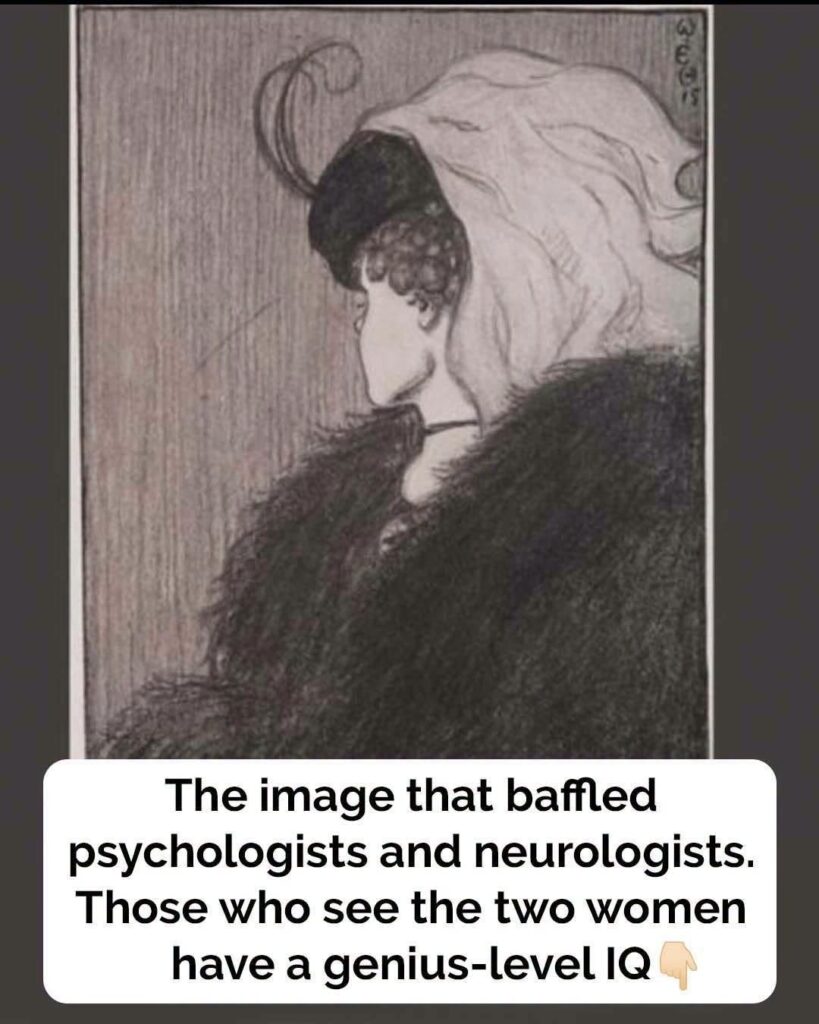
Few images in psychology have fascinated people as much as the famous optical illusion often known as “My Wife and My Mother-in-Law.” At first glance, most people see only one face. Yet with a shift in perception, an entirely different person suddenly appears.
Some viewers instantly spot a young woman looking away. Others immediately notice an older woman in profile. Many struggle to see both at the same time. This simple drawing has puzzled, entertained, and fascinated people for more than a century because it reveals something remarkable about how the human brain works.
The illusion is often shared online with claims that only highly intelligent people can see both images quickly. Others claim it measures IQ or reveals hidden personality traits. While those claims make for entertaining social media posts, the real science behind this visual puzzle is even more fascinating.
This classic illusion provides a window into perception, attention, cognitive flexibility, and the incredible ways our brains interpret the world around us. The image may seem simple, but it demonstrates some of the most complex processes occurring inside the human mind every second of every day.
Why Optical Illusions Fascinate Us
Humans naturally trust their eyes. From childhood, we learn to rely on vision more than almost any other sense. We assume that what we see accurately represents reality.
Optical illusions challenge that assumption.
When we encounter an illusion, we experience a strange conflict between what we know and what we see. Even after someone explains the trick, our brains often continue to perceive the illusion exactly the same way.
This creates a fascinating realization: seeing is not simply receiving information. Instead, seeing is an active process where the brain constantly interprets, predicts, fills gaps, and creates meaning from visual information.
Every second, our eyes collect enormous amounts of data. The brain cannot process every detail individually. Instead, it uses shortcuts and assumptions to build a coherent picture of the world.
Most of the time these shortcuts work brilliantly. They help us recognize faces instantly, navigate crowded environments, and react quickly to danger. However, optical illusions expose the shortcuts and assumptions our brains use behind the scenes.
That is why illusions continue to captivate scientists, psychologists, educators, and curious minds alike.
The Famous Young Woman and Old Woman Illusion
The image discussed in this challenge is among the most famous ambiguous figures ever created.
At first glance, many people see a young woman looking away from the viewer. Her face appears turned to the side. She seems elegant, youthful, and fashionable.
However, another image is hidden within the same lines.
When viewers shift their perspective, they suddenly notice an older woman facing left in profile. Her nose, mouth, chin, and eye emerge from features that previously belonged to the younger figure.
The remarkable aspect of this illusion is that nothing changes in the image itself. The lines remain identical.
Only your interpretation changes.
The young woman’s jaw becomes the old woman’s nose.
The young woman’s ear becomes the old woman’s eye.
The young woman’s necklace transforms into the old woman’s mouth.
The drawing contains both images simultaneously, yet most people can perceive only one at a time.
This switching effect reveals an important principle of human perception: our brains often choose one interpretation among several possible options.
The History Behind the Illusion
Although many people encounter this image through social media, its origins stretch back more than a century.
The illusion became widely known through a 1915 illustration by British cartoonist William Ely Hill. He titled the image “My Wife and My Mother-in-Law.”
The drawing quickly gained popularity because viewers could easily switch between seeing two completely different faces.
Psychologists soon recognized the image as a valuable tool for studying visual perception. Over time, it became one of the most cited examples of ambiguous visual processing.
Researchers discovered that factors such as age, attention, expectations, and even recent experiences can influence which face people notice first.
For example, some studies suggest younger participants may identify the young woman more quickly, while older participants may more readily perceive the older woman. These findings continue to generate interest among cognitive scientists studying how experience influences perception.
More than one hundred years after its creation, the illusion remains one of the most recognizable examples of how the brain interprets visual information.
What Is Bistable Perception?
The scientific term most commonly associated with this illusion is bistable perception.
Bistable perception occurs when a single visual stimulus supports two different interpretations.
The brain cannot comfortably hold both interpretations simultaneously, so it alternates between them.
Other famous examples include:
- The Rubin Vase illusion, where viewers see either a vase or two faces.
- The Necker Cube, where a wireframe cube appears to flip orientation.
- Certain spinning dancer illusions that seem to rotate in different directions.
In each case, the visual information remains unchanged.
What changes is the brain’s interpretation.
This phenomenon demonstrates that perception is not passive. Instead, perception involves active decision-making processes occurring below conscious awareness.
Your brain constantly asks questions such as:
- What object am I looking at?
- Which interpretation makes the most sense?
- What patterns match my previous experiences?
The answers help create the reality you experience.
Why Some People See One Face First
One of the most interesting aspects of this illusion is that different people often notice different faces immediately.
Why does this happen?
Several factors influence perception.
Expectations
What you expect to see strongly affects what you actually perceive.
If someone tells you the image contains a young woman, you may find that interpretation first.
If they mention an older woman beforehand, your brain may prioritize that version instead.
Expectations guide attention and influence perception more than most people realize.
Experience
Past experiences shape visual interpretation.
The brain continuously compares incoming information to stored memories.
People who frequently view portraits, artwork, or certain visual styles may interpret ambiguous images differently than others.
Focus and Attention
Small differences in where your eyes initially land can influence which image emerges first.
Looking at one area of the drawing may encourage the young woman interpretation.
Looking elsewhere may reveal the older woman immediately.
Cognitive Flexibility
Some individuals naturally switch between interpretations more quickly.
This ability is often associated with cognitive flexibility, which refers to the brain’s capacity to adapt to changing information and perspectives.
Does Seeing Both Mean You Have a High IQ?
Perhaps the most widespread myth surrounding this illusion is the claim that seeing both images quickly indicates genius-level intelligence.
This claim has no scientific basis.
While the illusion demonstrates cognitive flexibility and perceptual processing, it is not an IQ test.
Intelligence is a complex construct involving reasoning, memory, problem-solving, learning, creativity, and numerous other factors.
No single image can accurately measure all of those abilities.
The speed at which someone notices both faces may depend on:
- Familiarity with optical illusions
- Visual attention
- Expectations
- Previous exposure to the image
- Individual perceptual differences
Therefore, spotting both faces quickly does not prove exceptional intelligence, and taking longer does not indicate lower intelligence.
The illusion reveals how perception works, not how smart someone is.
What This Illusion Teaches About the Brain
The true value of this illusion lies in what it reveals about human cognition.
Many people assume vision works like a camera. A camera records information exactly as it appears.
The brain works differently.
Instead of recording reality, the brain constructs reality.
It takes incomplete information and creates the most likely interpretation.
This process happens continuously.
Every moment, your brain fills gaps, predicts outcomes, and organizes sensory information into meaningful patterns.
Without these abilities, navigating daily life would become overwhelming.
The young woman and old woman illusion demonstrates this beautifully.
Both interpretations exist within the same image.
Yet your brain selects one and temporarily ignores the other.
Only when attention shifts does the alternative interpretation emerge.
This process occurs not only with optical illusions but throughout everyday life.
The Role of Pattern Recognition
Humans are exceptional pattern-recognition machines.
Our ancestors survived partly because they could quickly recognize faces, threats, animals, and environmental changes.
Modern brains retain this remarkable ability.
Pattern recognition helps us:
- Read words
- Identify emotions
- Recognize friends
- Drive vehicles
- Learn new skills
However, pattern recognition can sometimes lead us astray.
The brain occasionally identifies patterns that are not actually present.
This tendency explains why people sometimes see faces in clouds, animals in rock formations, or hidden meanings in random events.
The illusion works because both facial patterns fit the same collection of lines.
The brain simply chooses one pattern over another.
Why Optical Illusions Are Valuable in Science
Optical illusions are more than entertaining puzzles.
Researchers use them to investigate fundamental questions about perception and cognition.
Illusions help scientists study:
- Attention
- Awareness
- Visual processing
- Decision-making
- Cognitive biases
- Brain organization
By observing how people interpret ambiguous images, researchers gain insights into how the brain resolves uncertainty.
These findings contribute to fields such as neuroscience, psychology, artificial intelligence, education, and medicine.
Understanding perception also helps researchers develop technologies that better align with how humans process information.
How to Train Yourself to See Both Images
If you struggle to identify the second face, several techniques may help.
Focus on Specific Features
Try identifying one feature at a time.
For the old woman:
- Look for the large nose.
- Find the eye hidden within the young woman’s ear.
- Notice the mouth formed by the necklace.
For the young woman:
- Focus on the jawline.
- Observe the eyelashes.
- Notice the neck and shoulder.
Breaking the image into components often makes the alternate interpretation easier to find.
Step Away Briefly
Looking away for a few seconds can reset visual attention.
When you return, your brain may process the image differently.
Relax Your Focus
Sometimes staring intensely makes switching perspectives harder.
Allowing your gaze to soften can encourage the alternative image to emerge naturally.
Practice with Other Illusions
The more experience people gain with ambiguous figures, the easier it becomes to switch between interpretations.
Why Social Media Loves These Challenges
Optical illusions thrive online because they generate immediate engagement.
People naturally want to compare experiences.
Questions like:
- Which face did you see first?
- How long did it take?
- Could you find both?
encourage discussion and sharing.
The image also creates a small sense of achievement when the hidden interpretation finally appears.
This reward motivates people to share the challenge with friends and family.
However, social media often exaggerates the meaning of these illusions by attaching unsupported claims about personality, intelligence, or psychological traits.
The actual science is usually more nuanced.
Still, the fascination remains understandable because these images provide a rare opportunity to watch perception change in real time.
The Bigger Lesson Hidden in the Illusion
Perhaps the most powerful lesson from this illusion extends beyond psychology.
The image reminds us that multiple interpretations can exist simultaneously.
Two people can look at the same information and initially reach different conclusions.
Neither interpretation is necessarily wrong.
The difference lies in perspective.
In the illusion, the young woman and old woman occupy the exact same drawing.
In life, many situations contain similar ambiguity.
Learning to consider alternative viewpoints often reveals information we initially overlooked.
The brain’s ability to switch perspectives is not merely a visual skill. It is also a valuable cognitive skill that supports creativity, problem-solving, empathy, and learning.
Final Thoughts
The famous young woman and old woman illusion continues to captivate people more than a century after its creation because it reveals something profound about human perception. A single image contains two completely different interpretations, yet most viewers initially see only one.
Rather than measuring intelligence, the illusion demonstrates the remarkable flexibility of the human brain. It highlights how perception depends on attention, expectations, experience, and cognitive processing.
Every time the image switches before your eyes, you witness your brain actively constructing reality from the information it receives. That process occurs constantly, not only when viewing illusions but throughout every moment of daily life.
So the next time you encounter this classic mind-bender, remember that the real mystery is not whether you can see both faces. The true wonder is how your brain transforms a collection of simple lines into entirely different realities, all within a fraction of a second.


Leave a Reply