
My son's golden curls were the first thing people noticed.
At the grocery store, strangers smiled at him before they smiled at me. Cashiers leaned over conveyor belts to compliment his hair. Elderly women stopped us in the produce aisle and said he looked like a little angel. His curls framed his face in soft, bright ringlets that bounced when he ran and fell into his eyes when he laughed.
Leo loved them.
He would shake his head after bath time and giggle as the wet curls sprang back into place. Sometimes he asked me to twirl one around my finger while he watched cartoons. To him, his hair was not a statement, a rebellion, or a problem.
It was just part of him.
My husband, Derek, loved Leo's curls too. He said they made our son look exactly like joy felt. I agreed.
But my mother-in-law, Margaret, hated them.
She never missed a chance to comment.
"Boys should have short hair."
"He looks like a girl."
"When are you finally going to cut that mop?"
At first, I laughed politely. Then I changed the subject. Eventually, I stopped responding altogether.
Derek always noticed. Under the table, he squeezed my hand whenever his mother started. It was his quiet way of saying, "I hear her. I'm with you."
And he was.
What Margaret did not know was that Leo's curls were not simply a style choice. They carried a promise. A child's promise. A promise so tender that I still cry when I remember the night he made it.
The Reason We Let Leo's Hair Grow
Leo met Sam in preschool.
They became best friends almost immediately. They built block towers together, shared snacks, raced toy cars across the classroom rug, and came home with paint on their sleeves and stories only they understood.
Sam was gentle, funny, and brave in the way only very young children can be.
Then Sam got sick.
He was diagnosed with leukemia when he was three years old.
At first, Leo did not understand. He knew Sam missed school. He knew adults spoke in softer voices when his name came up. He knew Sam went to the hospital and came home tired.
Then Sam began losing his hair.
That was the part Leo understood.
One night, while I tucked him into bed, Leo asked, "Mommy, why doesn't Sam have hair anymore?"
I explained as gently as I could. I told him that the medicine helping Sam get better was very strong, and sometimes strong medicine made hair fall out.
Leo was quiet for a long time.
Then he touched his own curls.
"Can I grow mine long?" he asked.
"Of course," I said. "But why?"
"So when Sam's hair grows back, mine will be long too," he whispered. "And if he feels sad, I can tell him we're growing it together."
I sat on the edge of his little bed and tried not to cry.
Later that night, I told Derek. He stood in the hallway with his hand over his mouth, eyes shining.
From that moment on, Leo's hair became something more than hair.
It became loyalty.
It became love.
It became a four-year-old's way of standing beside his best friend when he could not fix anything else.
Margaret Never Asked
Margaret had opinions, but she rarely had questions.
That was one of the hardest things about her.
She saw the curls and decided they were wrong. She never asked why we kept them. She never asked whether Leo liked them. She never asked whether there was a story.
She simply judged.
At family dinners, her comments grew sharper.
One Sunday, she looked directly at Leo and said, "A handsome little boy should not hide behind all that hair."
Leo looked down at his plate.
Derek's jaw tightened.
"Mom," he said quietly, "enough."
She rolled her eyes. "I'm only saying what everyone is thinking."
"No," he replied. "You're saying what you're thinking."
The table went silent.
I thought that might be the end of it.
I was wrong.
The Day She Cut His Hair
It happened on a Saturday afternoon.
I had a long list of errands. Derek had been called into work. Margaret offered to watch Leo for a few hours.
I hesitated.
She had been difficult, yes, but she was still his grandmother. And Leo enjoyed baking cookies with her.
So I said yes.
When I came home, the house felt strange before I even opened the door fully.
Too quiet.
No cartoons.
No laughter.
No little feet running toward me.
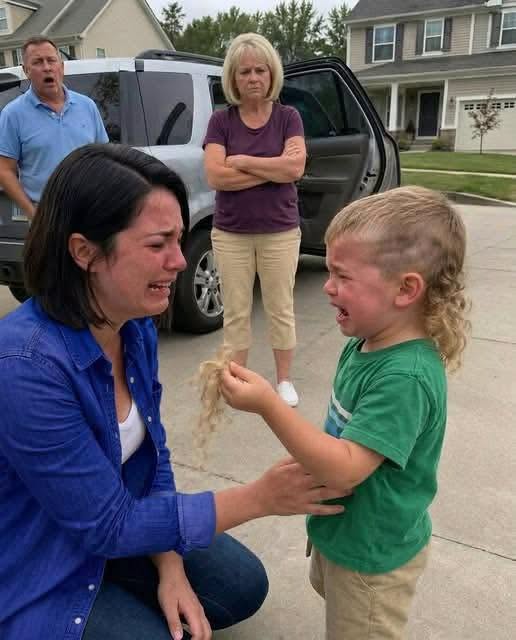
I found Leo sitting on the living room floor with his head bowed. His small hands rested in his lap. His shoulders trembled.
For a moment, I could not understand what I was seeing.
Then I saw the floor.
Golden curls scattered everywhere.
My son's beautiful ringlets lay across the rug, the sofa, the kitchen tile.
His hair had been hacked short. Unevenly. One side was shorter than the other. Small patches stuck out at odd angles. It looked rushed, careless, and cruel.
Margaret stood in the kitchen holding a broom.
"There," she said. "Now he looks like a proper little boy."
I could not speak.
Leo looked up at me, and his face broke.
"Mommy," he whispered, "Grandma cut my hair. She said it was ugly."
That sentence did something to me.
I crossed the room, picked him up, and carried him upstairs without saying a word to Margaret.
In his bedroom, I held him while he cried into my shoulder.
"My hair was for Sam," he sobbed. "Grandma didn't listen."
I called Derek.
When he answered, I said only, "Your mother cut Leo's hair."
There was silence.
Then Derek asked, "Is Leo okay?"
"No."
"I'm coming home."
His voice was calm, but I knew my husband. Calm meant dangerous. Calm meant controlled fury.
Before hanging up, he said, "Don't argue with her. Wait for me."
Dinner in Silence
Derek arrived twenty minutes later.
He went straight upstairs.
Leo was still curled against me, exhausted from crying.
Derek knelt in front of him and placed both hands gently on his son's face.
"I'm so sorry, buddy," he said.
Leo sniffed. "Sam's going to be sad."
Derek closed his eyes for a second.
Then he kissed Leo's forehead.
"We'll talk to Sam," he said. "And we'll grow it again if you want."
Leo nodded.
Downstairs, Margaret acted as if nothing terrible had happened.
She had started dinner.
Roast chicken. Mashed potatoes. Green beans.
The normalcy made me feel sick.
Derek looked at his mother, then at me.
"Let's eat," he said.
I stared at him.
Dinner?
But I knew his tone.
He had a plan.
So we sat.
Leo pushed potatoes around his plate. I barely touched my food. Margaret talked about her garden, a neighbor's new fence, and a sale at the department store.
Derek said almost nothing.
Then, after the plates were cleared, he folded his hands on the table and looked at his mother.
"Mom," he said, "do you know why Leo was growing his hair?"
Margaret sighed. "Because you two let him do whatever he wants."
"No," Derek said. "That's not why."
She waved a hand. "He needed a haircut. I did what you should have done months ago."
Derek's voice stayed quiet.
"That hair was for Sam."
Margaret frowned. "Who?"
"Leo's best friend."
Then Derek told her everything.
He told her about Sam's leukemia.
About chemotherapy.
About hair loss.
About the night Leo decided to grow his curls so Sam would not feel alone.
He told her how much those curls meant to our son.
He told her that Leo had not been trying to look a certain way. He had been trying to love someone.
With every sentence, Margaret's face changed.
First annoyance.
Then confusion.
Then shock.
Then shame.
When Derek finished, he leaned back in his chair.
"You didn't cut hair today," he said. "You cut a promise."
Margaret's eyes filled with tears.
"I didn't know," she whispered.
Derek nodded slowly.
"No," he said. "You didn't. Because you never asked."
What Happened After
Margaret cried.
She apologized to Leo.
She apologized to me.
She apologized to Derek.
At first, Leo would not look at her. Then, because he was four and his heart was softer than mine, he said, "It's okay, Grandma. It grows back."
That made Margaret cry harder.
But forgiveness from a child does not erase what happened.
Derek did not yell. He did not ban her forever. He did not create a dramatic scene.
Instead, he set boundaries.
Margaret was no longer allowed to watch Leo alone.
She was not allowed to comment on his hair, clothes, toys, emotions, or body.
If she broke that rule, visits ended immediately.
No debate.
No second warning.
For the first time in our marriage, Margaret did not argue.
She simply nodded.
Why It Hurt So Deeply
Some people might say, "It was just hair."
But it was not just hair.
It was Leo's body.
It was his choice.
It was his promise.
It was his way of processing something painful and frightening.
Adults often underestimate children's emotional depth. We assume they do not understand serious things because they cannot explain them like adults.
But children understand love.
They understand loyalty.
They understand sadness.
They understand when someone they care about is hurting.
Leo could not cure Sam's cancer. He could not take away hospital visits or medicine or fear. But he could grow his hair. So he did.
That mattered.
And Margaret took it without permission.
What Parents Should Remember
Children deserve respect.
That does not mean they control everything. Parents still guide, teach, and protect. But when a child expresses a preference about their own appearance, especially one rooted in kindness, adults should listen.
Hair grows back.
Trust grows back more slowly.
Leo learned that day that someone he loved might ignore his voice if she believed she knew better.
That is a painful lesson for a child.
It is also a lesson many adults need to unlearn.
Love is not control.
Concern is not permission.
Being older does not mean being right.
Sam's Reaction
The next day, we visited Sam.
I worried Leo would become upset again.
Instead, he walked into Sam's living room wearing a little baseball cap pulled low over his uneven haircut.
Sam looked at him for a moment.
Then he grinned.
"You got short hair like me."
Leo pulled off the cap.
"My grandma cut it," he said. "But I didn't want her to."
Sam touched his own soft regrowing hair.
"It's okay," he said. "We can grow it again."
And just like that, the boys moved on.
They built a fort out of couch cushions and spent the afternoon pretending to be astronauts.
I watched them from the doorway and cried quietly.
Children can be astonishingly resilient.
They can also be hurt deeply.
Both things can be true.
Margaret Tried to Change
In the months that followed, Margaret changed.
Not perfectly.
Not overnight.
But noticeably.
She stopped making comments about Leo's appearance.
She asked before offering opinions.
She began volunteering at a children's hospital.
She donated to a local cancer charity.
Sometimes she overcorrected and became awkwardly careful around us. But I preferred awkward care to confident cruelty.
One afternoon, she brought Leo a small wooden box.
Inside was a lock of his curls she had saved from the floor.
"I should have never cut them," she said. "But I kept these because I thought maybe someday you might want them."
Leo looked at the curls.
Then he looked at me.
I nodded.
He took the box and said, "Thank you."
That was the closest I came to forgiving her for a long time.
Where We Are Now
Years have passed.
Leo's curls grew back.
They are still golden.
Still wild.
Still beautiful.
Sam is healthy now. His hair grew back too, darker and softer than before. The boys are still best friends.
They play soccer together.
They build forts.
They argue over video games.
They have no idea how much their friendship taught the adults around them.
Margaret still visits, but never alone. She accepts that. She has become gentler. More thoughtful. Less certain that her way is the only way.
Derek and I are stronger because of what happened.
Not because it was easy.
Because he stood with us.
He did not minimize my pain.
He did not excuse his mother.
He did not say, "That's just how she is."
He told the truth at the dinner table and let it do what truth does.
It changed the room.
Final Thoughts
This story is about hair, but it is also about boundaries.
It is about how often adults make assumptions about children without asking questions.
It is about how easily love becomes control when people believe their opinions matter more than someone else's dignity.
Margaret saw curls and thought they needed fixing.
She should have seen a child making a promise to his sick best friend.
She should have asked.
That is the lesson I carry.
Before judging a child's hair, clothes, favorite toy, quiet mood, or unusual choice, pause.
There may be a reason.
There may be a story.
There may be love behind it.
And if you do not know, ask.
Because sometimes what looks like "just hair" is actually courage.
Sometimes what looks like a small choice is a child's way of holding someone else's hand.
And sometimes the most powerful thing a parent can do is protect that softness from people who mistake control for care.

Leave a Reply