
Looking back, Floam wasn’t particularly sophisticated.
Yet kids adored it.
Why?
Because it engaged every sense.
It looked weird.
It felt weird.
It made strange sounds.
It transformed shape endlessly.
Before smartphones and tablets dominated childhood entertainment, toys like Floam encouraged pure experimentation.
There was no objective.
No score.
No instructions.
Just endless possibilities.
You built something.
Destroyed it.
Built something else.
And repeated the process for hours.
The Mystery of Ancient Floam
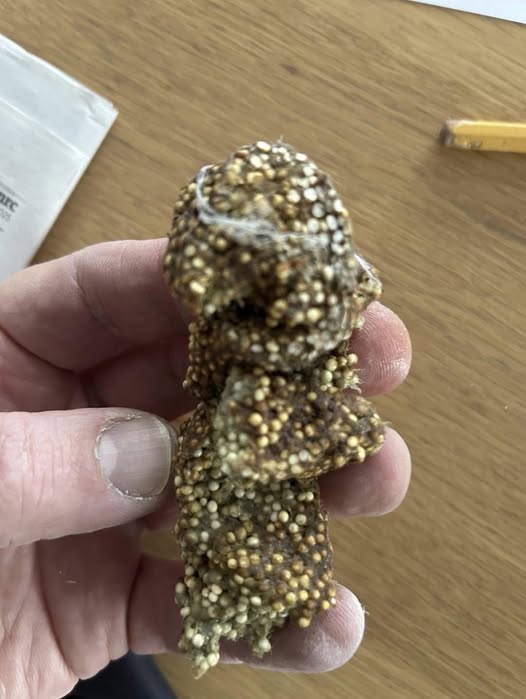
The specimen I discovered under the shelf had clearly survived decades.
Which raised an important scientific question:
How does Floam age?
Apparently not gracefully.
The bright colors had faded into a depressing grayish-green.
The once-soft texture had hardened into something resembling archaeological evidence.
The foam beads remained intact, however.
Those tiny little spheres looked almost exactly as they had when dinosaurs roamed toy store aisles.
Or at least when boy bands dominated the radio.
Nostalgia Is a Strange Thing
What fascinated me most wasn’t the Floam itself.
It was my reaction.
One glance at that crusty lump instantly transported me back years.
Suddenly I remembered:
- Saturday morning cartoons
- Toy store visits
- Summer afternoons
- School book fairs
- The smell of freshly opened toy packaging
Memory works in funny ways.
Sometimes a photograph triggers it.
Sometimes a song.
And sometimes it’s a forgotten blob of polymer and foam beads hiding beneath furniture.
Why These Discoveries Matter
As adults, we spend so much time focused on responsibilities.
Bills.
Deadlines.
Appointments.
Emails.
Finding something from childhood interrupts that rhythm.
For a moment, we’re reminded of a version of ourselves that existed before obligations took center stage.
The kid who thought a container of colorful goo represented unlimited entertainment.
The kid who could lose track of time for an entire afternoon.
The kid who wasn’t worried about productivity.
There is something surprisingly comforting about reconnecting with that person.
The Floam Hall of Fame
After my discovery, I asked several friends whether they remembered Floam.
The responses were immediate.
One remembered sticking it to bedroom walls.
Another admitted finding dried Floam inside an old backpack years later.
One confessed that a chunk remained embedded in family carpeting to this day.
Apparently, Floam’s true superpower wasn’t creativity.
It was permanence.
What Happened to It?
Like many beloved childhood toys, Floam eventually faded from the spotlight.
New trends arrived.
Technology evolved.
Attention spans shifted.
Yet for those who grew up during its peak popularity, Floam occupies a special corner of memory.
Not because it was revolutionary.
Not because it changed the world.
But because it was part of a particular moment in time.
A shared experience.
A tiny cultural artifact.
The Final Verdict
So what did I do with the ancient Floam?
After a brief moment of archaeological appreciation, I carefully scraped it into a trash bag and gave the area a thorough cleaning.
Some relics belong in museums.
Others belong in the garbage.
But the memory?
That stays.
It’s funny how nostalgia works.
You can spend weeks chasing happiness through expensive purchases, ambitious plans, or endless entertainment.
Then a forgotten toy emerges from beneath a shelf, and suddenly you’re smiling at memories you didn’t even realize were still there.
Not bad for a lump of dried-up Floam.
And definitely better than a dead mouse.



Leave a Reply