
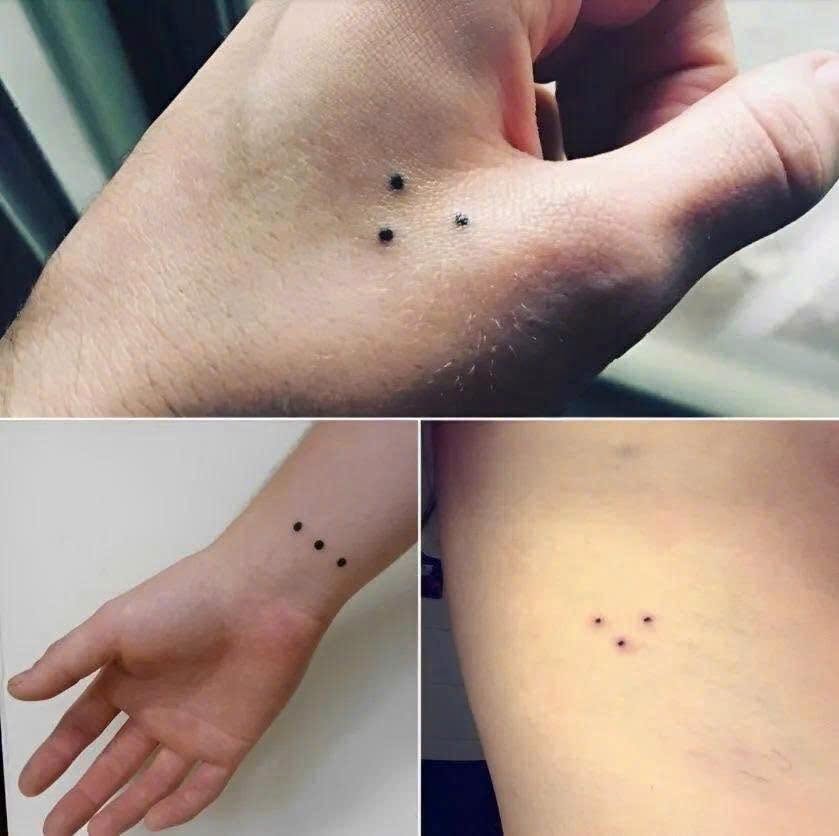
In the age of viral headlines and social media warnings, it is common to come across alarming claims about symbols, clothing, gestures, or tattoos. One headline that has circulated repeatedly over the years warns people that if they see someone with a three-dot tattoo, they should “run as far as they can.”
It is a dramatic statement. It is also an oversimplification.
The reality behind the three-dot tattoo is far more complex than fear-based articles often suggest. Like many symbols, its meaning depends heavily on context, culture, history, geography, and, most importantly, the person wearing it.
For some individuals, the three dots symbolize a difficult life journey. For others, they represent spirituality, personal growth, faith, or family. While the symbol has historically appeared in certain criminal and prison contexts, assuming that every person with a three-dot tattoo is dangerous is both inaccurate and unfair.
Understanding symbols requires curiosity rather than fear. Instead of relying on internet myths, it is worth exploring the actual history and meanings behind one of the world’s most recognizable minimalist tattoos.
The Three-Dot Tattoo: A Small Symbol With a Long History
Why Three Simple Dots Attract Attention
At first glance, three dots may seem too simple to carry any significant meaning. Yet throughout history, simple symbols have often held powerful messages.
The three-dot tattoo is usually arranged either:
- In a triangular pattern
- In a straight line
- On the hand, wrist, face, or arm
- As a very small minimalist design
Its simplicity is part of its appeal. Unlike large tattoos that require extensive artwork, three dots can be discreet while still holding personal significance.
Because the tattoo is small and easy to create, it has appeared in many different communities around the world over several decades.
The Problem With Assuming One Meaning
One of the biggest mistakes people make when interpreting tattoos is believing every symbol has only one definition.
Symbols evolve.
A design that started in one community may later spread into completely different groups with completely different meanings.
The cross, rose, butterfly, anchor, and skull all mean different things depending on who wears them. The three-dot tattoo is no different.
Judging someone based solely on a tattoo ignores the reality that personal expression is often far more nuanced than internet rumors suggest.
The Meaning of “Mi Vida Loca”
One of the Most Recognized Interpretations
Historically, one of the most widely known meanings of the three-dot tattoo is the Spanish phrase:
“Mi Vida Loca”
Translated into English, this means:
“My Crazy Life.”
This phrase became associated with certain Chicano and Latino communities and later appeared in some prison and gang cultures.
However, even this meaning is often misunderstood.
The phrase does not necessarily indicate violence or criminal behavior.
Instead, it frequently reflects a difficult life journey marked by hardship, survival, struggle, poverty, adversity, or resilience.
For many individuals, the tattoo symbolizes:
- Surviving difficult circumstances
- Enduring challenges
- Overcoming obstacles
- Accepting life’s unpredictability
In this context, the tattoo serves more as a personal statement than a threat.
Why Context Matters
A tattoo acquired decades ago inside a correctional institution may carry different implications than the same tattoo worn by a college student, artist, musician, or office worker.
Without understanding context, assumptions can quickly become stereotypes.
That is why experts on symbols, criminology, and cultural studies consistently emphasize the importance of looking beyond appearances.
Spiritual and Philosophical Meanings
Mind, Body, and Spirit
One of the most popular modern interpretations of the three-dot tattoo is:
Mind, Body, Spirit
This meaning focuses on balance and harmony.
People who choose this interpretation often view the tattoo as a reminder to care for every aspect of themselves rather than focusing on only one area of life.
The three dots symbolize:
- Mental wellness
- Physical health
- Spiritual growth
For these individuals, the tattoo serves as a daily reminder to pursue a balanced life.
Past, Present, and Future
Another common interpretation involves time.
The three dots may represent:
- The past
- The present
- The future
This symbolism encourages reflection while maintaining focus on the present moment.
People who choose this meaning often view the tattoo as a reminder that life is a journey.
The past shapes us.
The future motivates us.
But the present is where life actually happens.
Life’s Continuous Journey
Some individuals interpret the three dots as representing:
- Beginning
- Middle
- End
Or:
- Birth
- Life
- Death
These philosophical meanings connect the tattoo to larger questions about existence, purpose, and personal growth.
Rather than representing danger, the tattoo becomes a symbol of reflection and awareness.
Religious Interpretations
The Holy Trinity
Within Christian communities, three dots sometimes symbolize:
- Father
- Son
- Holy Spirit
Known as the Holy Trinity, this concept represents one of Christianity’s central beliefs.
For believers, the tattoo may serve as:
- A statement of faith
- A spiritual reminder
- A representation of divine unity
Like many religious tattoos, its meaning is deeply personal.
Faith in a Minimalist Form
Not everyone wants a large religious tattoo.
Some people prefer subtle designs that carry private significance.
Three small dots can express faith without requiring a large cross or elaborate religious artwork.
This simplicity explains why the design remains popular among individuals seeking meaningful yet understated tattoos.
The Influence of Prison and Gang Culture
Understanding the Historical Connection
It would be inaccurate to claim that the three-dot tattoo has never been associated with gangs or prison culture.
Historically, it has appeared in some criminal environments.
However, this association is often exaggerated by viral articles and social media posts.
The reality is more complicated.
In certain contexts, three dots have represented:
- Time spent incarcerated
- Loyalty to a group
- A difficult lifestyle
- Personal experiences within prison systems
Even within these environments, the meaning has varied.
There has never been a universal rule that every three-dot tattoo signifies gang membership.
Why Stereotypes Become Dangerous
The problem arises when people assume:
Tattoo = Criminal.
Reality does not work that way.
Millions of people have tattoos with no connection whatsoever to criminal activity.
Assuming otherwise can lead to:
- Unfair judgments
- Discrimination
- Social stigma
- Misunderstanding
People deserve to be evaluated by their actions, character, and behavior-not solely by body art.
Why Viral Headlines Spread Fear
Fear Gets Clicks
Many websites rely on attention-grabbing headlines.
Statements such as:
“If You See This Tattoo, Run!”
generate curiosity and emotional reactions.
Fear-based headlines work because humans are naturally drawn to potential threats.
Unfortunately, they often sacrifice accuracy in exchange for engagement.
The Psychology Behind Panic
Researchers have long understood that fear spreads faster than nuance.
A simple scary claim is easier to share than a detailed explanation.
As a result:
- Complex issues become oversimplified
- Stereotypes get reinforced
- Misinformation spreads quickly
The three-dot tattoo is just one example of this phenomenon.
Many ordinary symbols have been transformed into internet myths through repetition and exaggeration.
The Evolution of Tattoo Culture
Tattoos Are More Mainstream Than Ever
A few generations ago, tattoos were less common and often associated with specific subcultures.
Today, tattoos are part of mainstream society.
People from every profession wear tattoos, including:
- Doctors
- Teachers
- Lawyers
- Business owners
- Athletes
- Artists
- Parents
The meaning of tattoos has expanded dramatically.
Many people choose tattoos simply because they find them beautiful or meaningful.
Minimalist Tattoos Continue to Grow in Popularity
The rise of minimalist tattoo trends has increased the popularity of simple designs.
Three-dot tattoos appeal to people because they are:
- Small
- Affordable
- Easy to conceal
- Visually clean
- Highly customizable
For many wearers, the design is chosen purely for aesthetic reasons.
Not every tattoo carries a hidden message.
Sometimes art is simply art.
Why Curiosity Is Better Than Assumption
The Importance of Asking Questions
When people encounter unfamiliar symbols, curiosity often leads to better outcomes than fear.
Instead of assuming negative intentions, consider the possibility that a symbol has:
- Personal meaning
- Cultural significance
- Spiritual value
- Artistic purpose
Learning creates understanding.
Assumptions often create division.
Everyone Has a Story
A tattoo may represent:
- Recovery from illness
- Grief after loss
- Faith
- Family
- Survival
- Personal growth
The same symbol can mean completely different things to different people.
That is what makes human expression so fascinating.
Commonly Misunderstood Tattoos
The Three-Dot Tattoo Is Not Alone
Many tattoos have been misunderstood over the years.
Examples include:
Teardrop Tattoos
Often assumed to indicate violence, yet many people use them to memorialize loss or grief.
Spiderweb Tattoos
Sometimes associated with prison culture but also used to symbolize patience, creativity, or life’s interconnected nature.
Skull Tattoos
Frequently interpreted as aggressive despite often representing mortality, courage, or remembrance.
Number Tattoos
Can carry deeply personal meanings unrelated to criminal organizations.
The lesson remains the same:
Context matters.
Frequently Asked Questions
Does a three-dot tattoo always mean gang affiliation?
No.
While the tattoo has appeared in some gang and prison environments, many people wear it for completely unrelated reasons such as spirituality, personal growth, faith, or aesthetics.
Should I be worried if I see someone with a three-dot tattoo?
No.
A tattoo alone does not indicate whether someone is dangerous.
Behavior and actions are much better indicators of character than body art.
What is the most common modern meaning?
Today, many people associate the tattoo with:
- Mind, body, spirit
- Past, present, future
- Personal resilience
- Minimalist artistic expression
Can I get a three-dot tattoo even if I’m not part of its original culture?
Many people do.
However, it is wise to learn about the symbol’s history before choosing any tattoo so you understand its various interpretations.
Why do people continue believing scary stories about tattoos?
Fear spreads quickly online.
Simple warnings often receive more attention than balanced explanations, even when the reality is more nuanced.
Final Thoughts
The claim that you should “run as far as you can” if you see someone with a three-dot tattoo says more about internet sensationalism than it does about the tattoo itself.
Like most symbols, the three-dot tattoo carries different meanings for different people. For some, it represents resilience after hardship. For others, it symbolizes faith, balance, personal growth, or life’s journey. While the tattoo has historical connections to certain prison and gang contexts, reducing every wearer to that single interpretation ignores the complexity of human experience.
The next time you see a three-dot tattoo, remember that symbols rarely tell the entire story.
A few marks on someone’s skin cannot reveal their character, intentions, or worth.
People are more than their tattoos.
And understanding will always take us further than fear.



Leave a Reply