
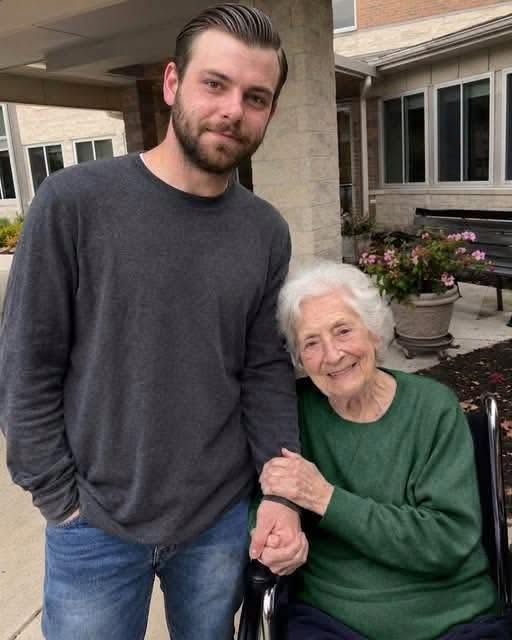
The Days That Followed
I returned the next afternoon.
Then the next.
And the next.
At first, I convinced myself it was just work.
But gradually something changed.
Mrs. Whitmore began to matter to me.
She remembered different versions of life every day.
Sometimes she believed she was thirty years old.
Sometimes she thought her husband had just left for work.
Occasionally she recognized that I wasn’t Michael.
Those days were heartbreaking.
She would look around the room and ask quietly,
“Why doesn’t my son visit anymore?”
I never knew how to answer.
The truth felt cruel.
The lie felt worse.
So I would simply sit beside her.
And listen.
Lessons I Never Expected
Over the following months, Mrs. Whitmore taught me things no school ever had.
She taught me that loneliness can be heavier than illness.
She taught me that people don’t stop needing love simply because they grow old.
She taught me that every person carries entire worlds inside them.
Stories.
Dreams.
Regrets.
Memories.
One afternoon she asked me a question that stayed with me.
“Do you know what people regret most at the end?”
I shook my head.
She smiled sadly.
“Not loving enough.”
Then she looked back out the window.
“Everything else seems so small.”
I thought about those words for days.
Maybe weeks.
Meeting the Real Michael
Nearly six months after I started, the real Michael finally arrived.
I had imagined him differently.
Warmer.
More involved.
Instead, he seemed rushed.
Polite but distant.
He thanked me for helping his mother.
Then he spent most of the visit checking emails on his phone.
Mrs. Whitmore barely recognized him that day.
Ironically, she believed I was her son.
Not him.
I watched the disappointment flicker across his face.
For the first time, I realized he was struggling too.
Dementia hadn’t only stolen memories from his mother.
It had taken something from him as well.
The woman who raised him was slowly disappearing.
Nobody teaches you how to grieve someone who is still alive.
The Final Conversation
One winter afternoon, I arrived to find Mrs. Whitmore unusually alert.
The staff told me she had been asking for me all morning.
When I entered her room, she smiled.
Not the confused smile I had grown accustomed to.
A clear one.
Present.
Certain.
She looked directly at me.
“You aren’t Michael.”
The words stunned me.
I nodded slowly.
“No.”
She reached for my hand.
“I know.”
For a moment, neither of us spoke.
Then she squeezed my fingers.
“You came anyway.”
I felt tears gathering instantly.
She continued.
“You sat with me.”
“You listened.”
“You cared.”
She smiled gently.
“That’s what matters.”
Not long afterward, she drifted off to sleep.
Goodbye
Mrs. Whitmore passed away three days later.
The nursing home called me that morning.
Even though I wasn’t family, they knew I would want to know.
I attended her small memorial service.
Only a handful of people were there.
The staff.
A few distant relatives.
Michael.
After the service ended, he approached me.
Without saying much, he handed me an envelope.
Inside was a letter.
It had been written by his mother years before her dementia became severe.
Near the end, one sentence had been underlined.
“If I am fortunate enough to be loved in my final years, I hope the people who love me understand what a gift they gave.”
Michael cleared his throat.
“She talked about you often.”
I couldn’t speak.
The Life She Changed
That was five years ago.
Today, I no longer work as a graphic designer.
I became a caregiver.
Eventually, I started working with seniors full-time.
The job I accepted out of desperation became a calling I never expected.
Whenever someone asks why I chose this path, I think about Mrs. Whitmore.
I think about a lonely woman sitting by a window.
I think about a lie that somehow led to truth.
And I remember the lesson she left behind:
People rarely remember what we achieve.
They remember how we made them feel.
I was hired to pretend to be someone’s son.
Instead, I found a purpose.
And in the end, an elderly woman who often couldn’t remember her own past gave me a future I never could have imagined.

Leave a Reply