
The Strange Discovery That Almost Ruined Breakfast
It started like any ordinary morning.
I walked into the kitchen, brewed a fresh cup of coffee, and pulled a carton of eggs from the refrigerator. Breakfast was going to be simple: eggs, toast, and a few quiet moments before the day became busy.
Then something caught my eye.
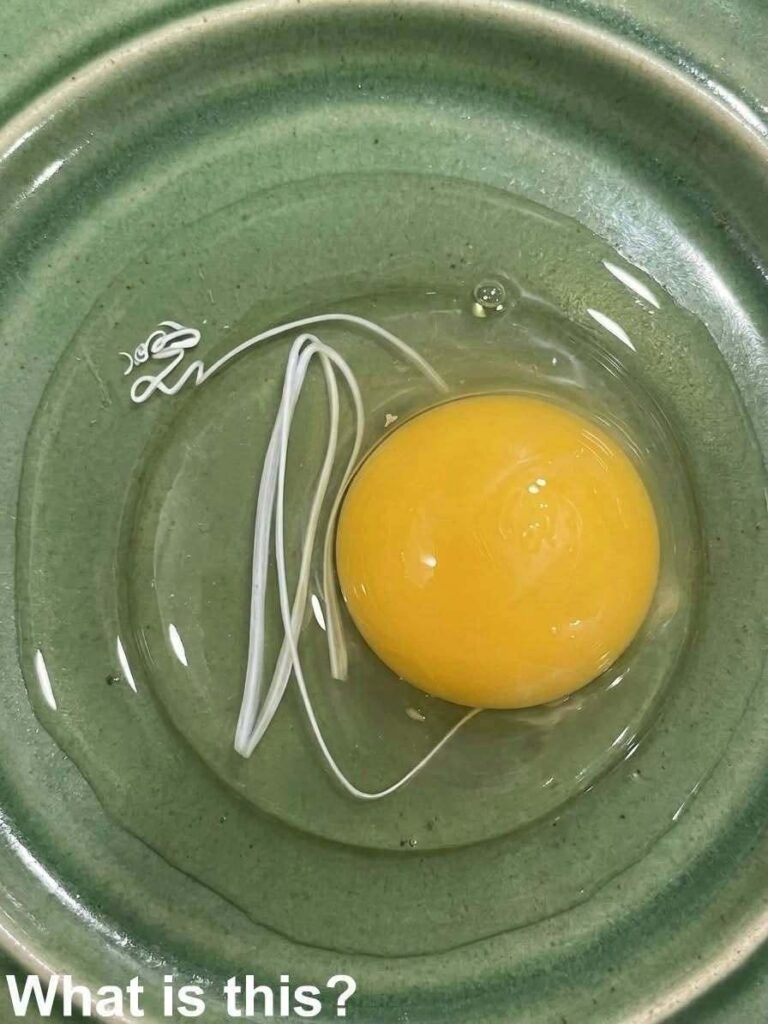
As I cracked an egg into a bowl, I noticed a strange white strand attached to the yolk. It looked thin, twisted, and slightly opaque. At first glance, it resembled a tiny string floating inside the egg white.
My stomach immediately tightened.
Like many people, I instantly jumped to worst-case scenarios.
Was it a parasite?
A worm?
A sign the egg had gone bad?
Had I accidentally bought contaminated eggs?
Within seconds, my appetite disappeared.
I seriously considered throwing the entire bowl into the trash.
But curiosity got the better of me.
Instead of tossing breakfast, I opened my phone and started researching.
What I discovered completely changed how I look at eggs.
That mysterious white strand wasn’t dangerous at all.
In fact, it was one of the strongest signs that the egg was fresh.
Meet the Chalaza: The Egg’s Built-In Safety System
What Is the White String Called?
That white strand has a name:
The chalaza.
Pronounced:
kuh-LAY-zuh
The plural form is:
chalazae
Most people have seen it before without realizing it.
Others notice it for the first time and immediately become concerned.
The truth is much less dramatic.
The chalaza is a natural part of every egg.
What Does It Do?
Think of the chalaza as a tiny suspension system.
Its job is to hold the yolk securely in the center of the egg.
Without it, the yolk would move around freely and become more vulnerable to damage.
The chalaza consists primarily of protein fibers that act like small anchors.
These anchors connect the yolk to membranes inside the egg.
As a result, the yolk stays centered and protected.
Nature essentially engineered a shock absorber inside every egg.
Why Eggs Need a Chalaza
Protection During Development
Before eggs became a staple breakfast food, they had a much more important purpose.
Their biological role was to support the development of a chick.
Inside a fertilized egg, maintaining the proper position of the yolk is extremely important.
The chalaza helps prevent excessive movement.
This protection keeps the developing embryo properly oriented.
Even in eggs intended for food, the structure remains part of the egg’s natural design.
A Remarkably Effective System
The more scientists study eggs, the more impressive they become.
Eggs contain:
- Protective membranes
- Nutrient-rich yolks
- Shock-absorbing structures
- Natural antibacterial defenses
- Strong shells
The chalaza is simply one component of an incredibly sophisticated package.
What initially looks strange is actually evidence of remarkable biological engineering.
The Chalaza Is a Sign of Freshness
Bigger Chalaza Usually Means Fresher Eggs
One of the most surprising discoveries about the chalaza is that it often becomes more noticeable in fresher eggs.
Many people assume the opposite.
They see the strand and worry that something is wrong.
In reality, prominent chalazae are often associated with recently laid eggs.
As eggs age:
- The egg white becomes thinner
- Internal structures weaken
- The chalaza becomes less obvious
Therefore, seeing a strong, visible chalaza is often a positive sign.
Why Fresh Eggs Look Different
Fresh eggs frequently display characteristics that surprise consumers.
These may include:
- Thicker whites
- Higher yolks
- More visible chalazae
- Firmer textures
People accustomed to older supermarket eggs sometimes mistake these features for problems.
Actually, they’re signs of quality.
Common Myths About the White String
Myth #1: It’s a Worm
This is probably the most common fear.
The chalaza can appear worm-like because of its shape.
However, it is not an organism.
It is not alive.
It is not a parasite.
It is simply a protein structure naturally present inside the egg.
Myth #2: It Means the Egg Is Fertilized
Another misconception is that the chalaza indicates fertilization.
This is false.
Both fertilized and unfertilized eggs contain chalazae.
The structure exists regardless of whether an embryo is present.
Myth #3: It Means the Egg Is Spoiled
Many people throw away perfectly good eggs because they mistake the chalaza for spoilage.
The presence of a chalaza has nothing to do with freshness in a negative sense.
In fact, it often indicates the opposite.
Myth #4: It’s Unsafe to Eat
The chalaza is completely edible.
It consists primarily of protein.
Millions of people consume it regularly without ever noticing.
There is no need to remove it for food safety reasons.
Should You Remove the Chalaza?
Most People Leave It In
For everyday cooking, there is no reason to remove the chalaza.
Whether you’re making:
- Scrambled eggs
- Omelets
- Quiches
- Fried eggs
- Egg sandwiches
the chalaza cooks normally alongside the rest of the egg.
Most people never notice it after cooking.
When Some Bakers Remove It
Professional bakers occasionally remove chalazae when preparing recipes that require extremely smooth textures.
Examples include:
- Custards
- Pastry creams
- Certain delicate desserts
Even then, removal is done for texture rather than safety.
For home cooks, it’s rarely necessary.
Other Strange Things You Might See in Eggs
Small Blood Spots
Occasionally, eggs contain tiny red or brown spots.
These are called blood spots.
Despite their alarming appearance, they are generally harmless.
They occur when small blood vessels rupture during egg formation.
Commercial grading processes remove most affected eggs, but some occasionally reach consumers.
Cloudy Egg Whites
Many people assume clear egg whites indicate freshness.
Actually, cloudy egg whites are often a sign of a fresh egg.
The cloudiness results from carbon dioxide that hasn’t yet escaped through the shell.
Double Yolks
Finding two yolks inside one egg can feel like winning a lottery.
Double yolks occur when a hen releases two yolks before the shell forms.
They’re unusual but completely safe.
Floating Eggs
An egg that floats in water may indicate age.
As eggs lose moisture over time, air pockets grow larger.
A floating egg isn’t automatically unsafe, but it deserves closer inspection before use.
Why Eggs Fascinate Scientists
Nature’s Perfect Package
Eggs have been studied extensively because they represent one of nature’s most efficient biological systems.
Inside a single shell, an egg contains:
- Nutrients
- Water
- Proteins
- Protective structures
- Growth-supporting components
Every part serves a purpose.
Even features that appear strange at first glance contribute to the egg’s function.
Tiny Details Matter
The chalaza is a perfect example.
Most people never think about it.
Yet without it, the egg would function very differently.
Small details often reveal the brilliance of natural design.
Frequently Asked Questions
What is the white string in an egg?
The white string is called the chalaza, a natural protein structure that helps keep the yolk centered inside the egg.
Is the chalaza a parasite?
No.
The chalaza is not a parasite, worm, or living organism.
It is a completely normal part of the egg.
Is it safe to eat?
Yes.
The chalaza is fully edible and safe to consume.
Do all eggs have chalazae?
Yes.
Every egg contains chalazae, although they may be more noticeable in some eggs than others.
Does a visible chalaza mean the egg is fresh?
Often, yes.
A prominent chalaza can be an indicator of freshness because it tends to weaken as eggs age.
Should I remove it before cooking?
Usually not.
Most recipes do not require removal.
Only certain specialty recipes may benefit from straining it out for texture purposes.
The Lesson Hidden Inside a Breakfast Egg
What began as a moment of panic ended up becoming a lesson in curiosity.
I nearly threw away a perfectly good egg because I misunderstood something completely normal.
The experience reminded me how quickly fear can take over when we encounter something unfamiliar.
Sometimes the things that look strange are actually signs that everything is working exactly as it should.
The next time you crack an egg and notice that mysterious white string attached to the yolk, don’t panic.
It isn’t a parasite.
It isn’t contamination.
It isn’t a warning sign.
It’s the chalaza-a small but remarkable structure that has been quietly doing its job inside eggs all along.
And chances are, you’ve been eating it your entire life without ever realizing it.



Leave a Reply