
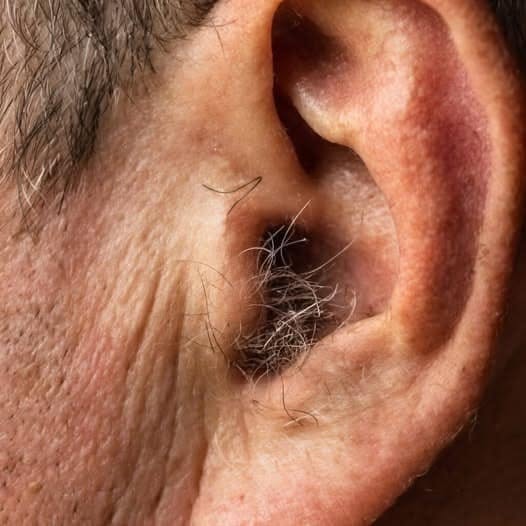
Genetics Have a Strong Influence
Family history plays an important role.
Look at Your Relatives
If your:
- Father
- Grandfather
- Uncles
- Older siblings
developed noticeable ear hair, there’s a good chance you may experience similar changes.
This doesn’t mean the outcome is guaranteed.
However, genetics often influence how hair follicles respond to aging and hormones.
Different People Experience Different Patterns
Some individuals develop only a few fine hairs.
Others may experience thicker growth.
Both outcomes can be entirely normal.
The Concept of Hair Redistribution
One of the most interesting aspects of aging hair is that it doesn’t simply increase or decrease.
Instead, it often redistributes.
Why This Happens
As hormonal sensitivity changes:
- Scalp hair may become thinner
- Ear hair may become thicker
- Nose hair may become more noticeable
- Eyebrows may become bushier
This shift reflects changes in follicle behavior rather than overall hair production.
A Protective Purpose
Scientists believe some of these changes may serve protective functions.
For example, ear and nose hairs help:
- Trap dust
- Filter particles
- Reduce environmental exposure
While they may be cosmetically inconvenient, they continue performing useful roles.
What About Women?
Many people assume ear hair is exclusively a male issue.
That isn’t true.
Women Can Develop Ear Hair Too
Although it is often less noticeable, women may also experience increased ear or facial hair as they age.
The Role of Menopause
During menopause:
- Estrogen levels decline
- Hormonal balance shifts
- Androgen effects may become more noticeable
As a result, some women observe:
- Coarser facial hair
- Chin hairs
- Ear hair
- Increased eyebrow growth
These changes are common and generally not cause for concern.
Debunking Common Ear Hair Myths
Several persistent myths continue to circulate.
Let’s separate fact from fiction.
Myth #1: Ear Hair Means Heart Disease
This claim has been repeated for decades.
The Reality
Current evidence does not establish ear hair as a reliable indicator of heart disease.
Both ear hair and cardiovascular disease become more common with age.
This shared association can create confusion.
Age-not ear hair itself-is the stronger explanation.
Myth #2: Trimming Makes Hair Grow Back Thicker
This belief applies to ear hair, facial hair, and body hair.
The Reality
Hair does not grow back thicker after trimming.
What actually happens is simple:
- Newly cut hair has a blunt tip
- Blunt tips feel coarser
- The hair appears thicker
The follicle itself remains unchanged.
Myth #3: Ear Hair Means Poor Hygiene
Ear hair has nothing to do with cleanliness.
It develops because of:
- Hormones
- Genetics
- Aging
People with excellent hygiene can develop prominent ear hair.
People with minimal grooming can have very little.
There is no connection.
Myth #4: Only Men Get Ear Hair
Women can experience ear hair growth too, especially after menopause.
The difference is often one of degree rather than possibility.
Should You Remove Ear Hair?
Whether or not to groom ear hair is entirely a personal choice.
There Is No Medical Requirement
Most ear hair does not need removal.
It is harmless and often performs useful protective functions.
Some People Prefer Grooming
Many individuals choose to trim visible hairs for cosmetic reasons.
This is perfectly reasonable.
The key is doing so safely.
Safe Ear Hair Grooming Options
Electric Ear Trimmers
These devices are specifically designed for ear and nose hair.
Benefits include:
- Convenience
- Safety
- Minimal discomfort
- Reduced injury risk
For most people, this is the safest option.
Professional Grooming
Barbers and grooming professionals often provide ear hair trimming services.
This may be helpful for individuals with extensive growth.
Small Grooming Scissors
Specialized rounded-tip scissors can be used carefully.
However, extra caution is necessary to avoid injury.
What You Should Avoid
Do Not Use Sharp Tweezers Aggressively
Pulling hairs can sometimes lead to:
- Irritation
- Inflammation
- Ingrown hairs
- Infection
Avoid Deep Trimming
Ear hair serves a protective purpose.
Removing large amounts deep within the ear canal may reduce this natural filtering function.
Focus only on visible hairs near the outer ear.
Never Insert Sharp Objects Into the Ear Canal
Safety should always take priority over appearance.
When Ear Hair Might Require Medical Evaluation
Most ear hair is entirely normal.
However, certain situations warrant medical attention.
Consult a Healthcare Professional If You Notice
- Sudden excessive hair growth
- Rapid changes in hair distribution
- Other unusual hormonal symptoms
- Significant skin changes
- Persistent irritation
These situations are uncommon but may justify further evaluation.
Healthy Aging Includes Physical Changes
One reason people worry about ear hair is that it serves as a visible reminder of aging.
Aging Is Normal
Over time, many natural changes occur:
- Hair grays
- Skin wrinkles
- Vision changes
- Hair distribution shifts
These developments are part of the normal aging process.
Ear Hair Is Simply One Example
Although society rarely discusses it openly, ear hair is one of the most common age-related changes experienced by both men and women.
There’s nothing unusual or unhealthy about it.
The Bottom Line
Ear hair after age 50 is a completely normal biological change driven by hormones, genetics, and the natural aging process. As hair follicles become more sensitive to androgens over time, growth often increases in areas such as the ears and nose while scalp hair may gradually thin.
Despite persistent myths, ear hair is not a sign of poor hygiene, does not automatically indicate heart disease, and is not exclusive to men. For many people, it simply reflects the body’s natural adaptation to aging.
If visible ear hair bothers you, safe trimming options are widely available. If it doesn’t, there’s no medical reason to remove it. Either way, understanding the science behind this common change can help replace embarrassment with reassurance.
Sometimes the most ordinary signs of aging are simply reminders that the body continues evolving throughout life-and ear hair is one of them.


Leave a Reply