
A Closer Look Raises More Questions
Rather than picking it up immediately, we spent a few minutes examining it from a distance.
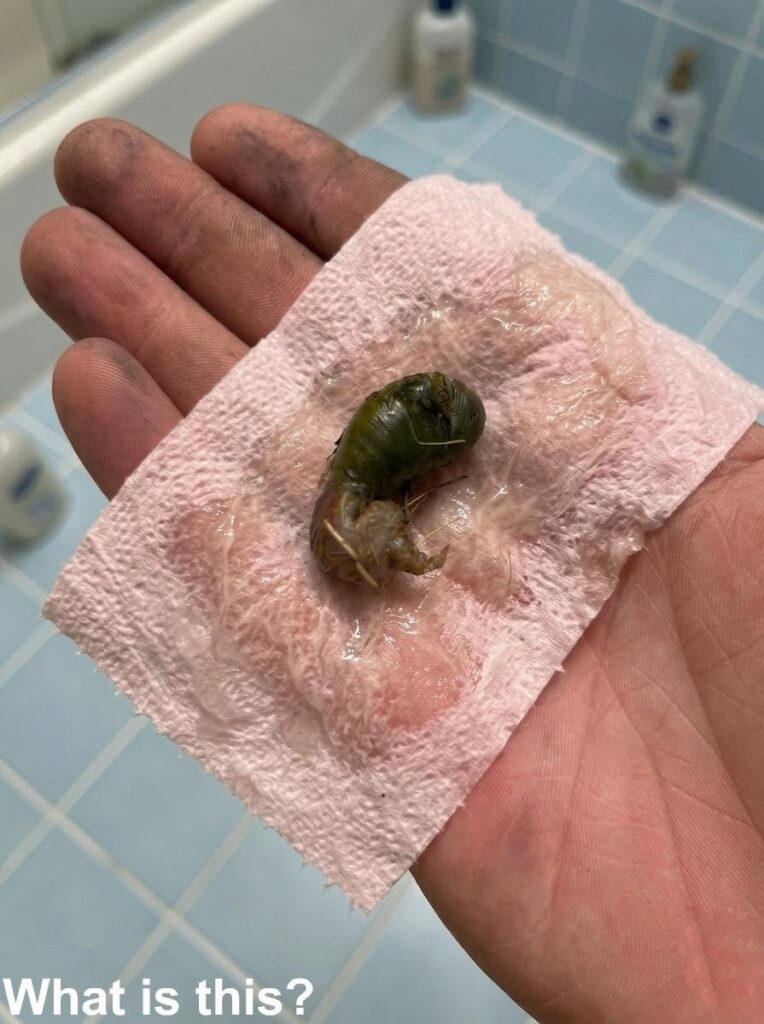
The object displayed several interesting characteristics:
- A soft green coloration
- Distinct body segments
- A slightly curved shape
- Smooth yet structured surfaces
The more we studied it, the less certain we became.
Its appearance suggested something biological, yet it lacked any obvious features that would immediately reveal its identity.
We considered several possibilities:
- Plant material
- Seed pod
- Insect casing
- Chrysalis
- Larval stage of an insect
Each explanation seemed plausible, but none felt entirely convincing.
Investigating the Unknown
Eventually, my husband carefully lifted the object using a tissue and placed it in a small clear container.
Viewed more closely, additional details became visible.
The segmented structure appeared highly organized.
Its texture seemed delicate but intact.
Most importantly, it looked like something in the middle of a transformation rather than a finished organism.
That observation shifted our thinking.
Instead of asking what it was, we began asking what it might become.
The Surprising Identification
After searching online resources, comparing photographs, and reading descriptions from insect guides, we finally found a likely answer.
The mysterious green object was a beetle pupa.
Suddenly, many of its unusual features made sense.
What had initially appeared strange and unfamiliar was actually a normal stage in one of nature’s most remarkable life cycles.
What Is a Beetle Pupa?
Most people are familiar with caterpillars transforming into butterflies.
However, many beetles undergo an equally fascinating process called complete metamorphosis.
Their life cycle generally includes four stages:
- Egg
- Larva
- Pupa
- Adult beetle
The pupal stage acts as a transitional period between the larval and adult forms.
During this stage, the insect undergoes dramatic internal changes.
Although the pupa appears inactive from the outside, a remarkable transformation is taking place beneath its protective outer layer.
When development is complete, an adult beetle emerges.
Why Would a Beetle Pupa Be Inside a Bathroom?
This was the next mystery we wanted to solve.
Although bathrooms may seem like unusual places for insect development, there are several possible explanations.
It Accidentally Wandered Indoors
Some beetle larvae travel considerable distances while searching for a suitable place to pupate.
A small opening under a door, near a window, or around plumbing fixtures may have provided access to the house.
It Arrived on Plants
If you keep houseplants or recently brought flowers indoors, an insect may have hitched a ride unnoticed.
Many insects spend portions of their lives on vegetation before seeking a sheltered location for pupation.
It Sought a Protected Environment
Pupae are vulnerable.
Some species naturally seek hidden, quiet locations where they can complete development with minimal disturbance.
A corner of a bathroom may have simply offered a safe temporary shelter.
The Hidden Drama Inside a Pupa
One reason insect pupae fascinate scientists is the extraordinary biological transformation occurring within them.
During metamorphosis:
- Larval tissues break down
- Adult structures develop
- Wings, legs, and reproductive organs form
- Body systems reorganize
The insect effectively rebuilds itself.
Although it appears motionless from the outside, immense biological activity is taking place internally.
This process is one of nature’s most remarkable examples of transformation.
Should You Be Concerned?
In most cases, discovering a single beetle pupa is not a cause for alarm.
A lone pupa generally indicates that an individual insect happened to find its way indoors rather than signaling a widespread infestation.
However, if you repeatedly find:
- Large numbers of insects
- Multiple larvae
- Numerous pupae
- Signs of stored-food pests
it may be worthwhile to investigate further.
For isolated discoveries, simple observation is usually sufficient.
What We Chose to Do
After identifying the pupa, our concern shifted to curiosity.
Rather than discarding it immediately, we placed the container in a safe location and monitored it periodically.
We wondered:
What species would emerge?
How long would the transformation take?
Would we actually witness the final stage?
Although many people might have overlooked or removed the object without a second thought, the experience became a small reminder of how much unnoticed life exists around us every day.
Lessons from an Unexpected Discovery
Sometimes the most ordinary moments reveal something extraordinary.
What began as confusion over an unfamiliar object on a bathroom floor evolved into a lesson about insect biology, metamorphosis, and the hidden complexity of the natural world.
It’s easy to assume that every mysterious creature is a pest or problem.
Yet many are simply participants in natural processes unfolding all around us.
Frequently Asked Questions
What is a beetle pupa?
A beetle pupa is a transitional stage between the larval and adult forms of a beetle during complete metamorphosis.
Is a beetle pupa dangerous?
Most beetle pupae are harmless and do not pose a threat to people.
Can a beetle pupa move?
Some species may show slight movement when disturbed, but pupae are generally much less active than larvae or adults.
How long does the pupal stage last?
The duration varies by species and environmental conditions but can range from several days to several weeks.
Should I remove a beetle pupa from my home?
If desired, it can be carefully relocated outdoors to a protected area where it can continue developing naturally.
Final Thoughts
The mysterious green object we discovered on our bathroom floor turned out not to be a threat, a strange household item, or an unknown creature. Instead, it was a beetle pupa-an insect quietly undergoing one of nature’s most incredible transformations.
What initially seemed puzzling became a fascinating reminder that even the smallest discoveries can open a window into the natural world. Sometimes, all it takes is a little curiosity to transform confusion into wonder.


Leave a Reply