
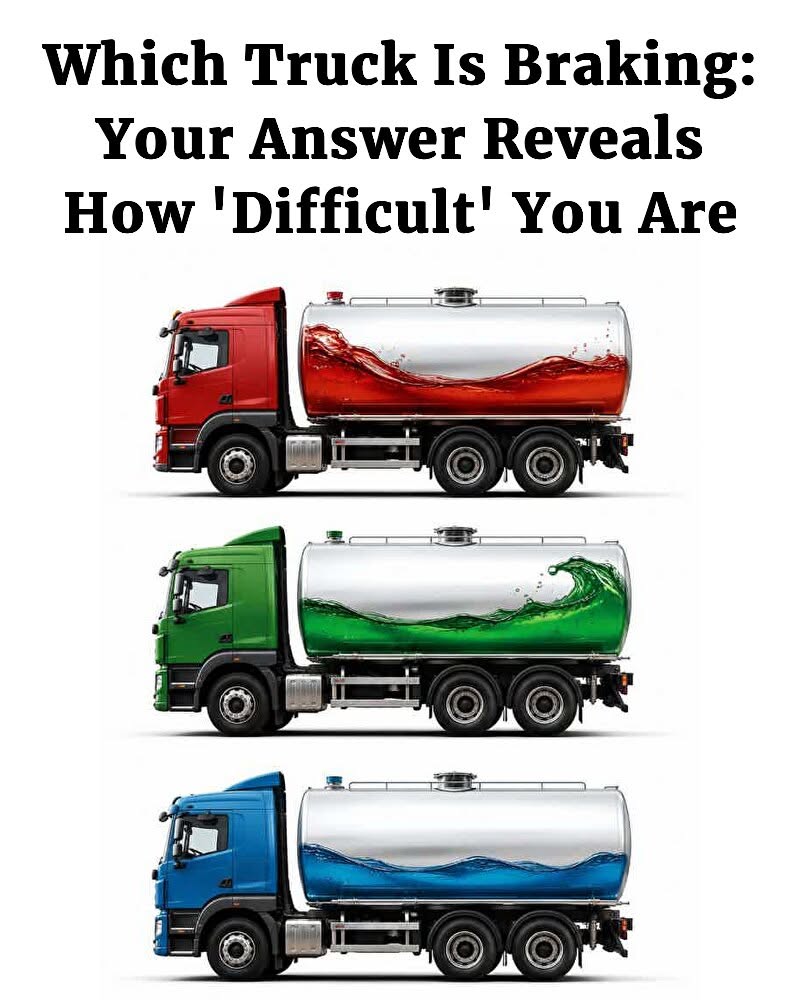
If you’ve spent any time on social media lately, you’ve probably seen one of those viral images showing two or three trucks and asking a simple question:
“Which truck is braking?”
Sometimes the image comes with an extra twist:
“Your answer reveals your personality.”
According to the caption, choosing Truck A means you’re stubborn. Choosing Truck B means you’re intelligent. Choosing Truck C means you’re emotional, creative, difficult, or secretly a genius.
Millions of people love these puzzles. They generate thousands of comments, spark debates among friends, and encourage everyone to defend their choice.
But here’s the interesting truth:
The puzzle itself can be based on real physics.
The personality interpretation almost certainly is not.
Let’s explore why these truck puzzles are so popular, how to solve them correctly, and what your answer actually reveals about the way your brain processes information.
Why These Puzzles Go Viral
The genius of these puzzles lies in their simplicity.
At first glance, they appear incredibly easy.
It’s just a truck.
Or maybe two trucks.
How hard can it be?
Then you look closer.
Suddenly you’re analyzing wheel positions, cargo movement, shadows, weight distribution, suspension angles, and vehicle motion.
People become invested because they believe there is one correct answer.
Add a personality claim on top of that and the engagement skyrockets.
Nobody wants to believe they picked the “wrong” truck.
The Basic Physics Behind Braking
To understand these puzzles, you need to understand one simple concept:
Momentum
When a vehicle is moving forward, everything inside the vehicle is also moving forward.
If the driver suddenly hits the brakes, the truck slows down.
But the cargo still wants to continue moving forward.
This creates a forward shift of weight.
That’s why you feel yourself lean forward when a car brakes suddenly.
Your body wants to keep moving.
The same principle affects trucks.
What Happens When a Truck Brakes?
When braking occurs, several things happen simultaneously.
Weight Transfers Forward
The front wheels experience increased load.
The rear wheels experience reduced load.
This is known as weight transfer.
The Front Dips Slightly
Because more weight shifts forward, the suspension compresses slightly at the front.
The nose of the truck may appear lower.
Cargo Moves Forward
Loose cargo tends to shift toward the front wall of the truck.
This is often the biggest clue in puzzle images.
Rear Suspension Lifts Slightly
As weight leaves the rear axle, the rear of the truck may rise slightly.
What Happens During Acceleration?
Acceleration produces the opposite effect.
When a truck speeds up:
- Weight shifts backward
- The front rises slightly
- The rear squats lower
- Cargo slides toward the back
Many viral puzzles intentionally show one truck accelerating and another braking.
The challenge is identifying which one is doing what.
The Most Common Clue: Cargo Position
Many truck puzzles contain loose cargo.
Boxes.
Sand.
Logs.
Barrels.
Rocks.
Liquid tanks.
The cargo usually provides the answer.
If the cargo is piled toward the front of the truck, braking is likely occurring.
If the cargo is piled toward the rear, acceleration is more likely.
This works because inertia causes objects to resist changes in motion.
The truck changes speed.
The cargo tries to keep doing what it was already doing.
Why People Get Different Answers
Interestingly, many people looking at the same image reach different conclusions.
This happens because our brains prioritize different visual information.
Some people focus on:
- The truck body
- The wheels
- The cargo
Others focus on:
- Shadows
- Angles
- Visual balance
- Shape
This leads to disagreement.
And disagreement is exactly what makes these puzzles spread online.
The Personality Claim
Now let’s talk about the part that usually accompanies these puzzles:
“Your answer reveals your personality.”
This is where things become much less scientific.
A typical post might say:
“If you chose Truck A, you’re logical.”
“If you chose Truck B, you’re stubborn.”
“If you chose Truck C, you’re emotional.”
Sounds fun.
But there’s no evidence that selecting a truck in a visual puzzle can reveal deep personality traits.
None.
Psychologists have never demonstrated that answering these puzzles accurately predicts someone’s character.
Why These Claims Feel True
Even though the claims aren’t scientific, many people feel shocked by how accurate they seem.
This happens because of a psychological phenomenon called the Barnum Effect.
The Barnum Effect occurs when people accept vague, general statements as uniquely personal.
For example:
“You sometimes doubt yourself.”
“You care deeply about certain people.”
“You can be outgoing but also enjoy time alone.”
Almost everyone can relate to statements like these.
Because they feel personal, people assume the test must know something about them.
Personality puzzle creators use this effect constantly.
The Brain Loves Meaning
Humans are natural pattern seekers.
We look for meaning everywhere.
We search for:
- Hidden messages
- Symbols
- Signs
- Personality clues
- Secret insights
This tendency helped our ancestors survive.
Recognizing patterns quickly allowed humans to detect danger, identify opportunities, and understand social situations.
Today, the same tendency makes us love personality quizzes.
Our brains enjoy connecting simple choices to deeper meanings.
What Your Answer Might Actually Reveal
Although the personality claims are questionable, your answer may reveal something real.
Not about your personality.
But about your observation style.
For example:
Detail-Oriented Thinkers
Some people immediately focus on cargo movement.
They examine physical clues carefully.
Big-Picture Thinkers
Others look at the overall shape of the truck.
They rely on intuition.
Analytical Thinkers
Some mentally simulate the truck’s motion.
They imagine what happens during braking.
Fast Decision-Makers
Others choose instantly based on first impressions.
None of these approaches is necessarily better.
They simply reflect different ways of processing visual information.
Why These Puzzles Are Good Brain Exercise
Despite their lack of scientific personality insight, these puzzles have genuine value.
They encourage:
Observation
You learn to notice small details.
Reasoning
You apply logic and physics.
Critical Thinking
You evaluate evidence before deciding.
Discussion
You compare answers with others.
Cognitive Flexibility
You learn alternative ways to interpret information.
That makes them more than simple entertainment.
They’re miniature mental workouts.
Common Mistakes People Make
Assuming the Personality Result Is Scientific
This is probably the biggest mistake.
Most personality descriptions attached to viral puzzles are created solely for engagement.
Ignoring Physics
Many people choose based on appearance rather than actual motion clues.
Overthinking
Sometimes the simplest explanation is the correct one.
Underthinking
Sometimes the puzzle includes subtle clues that require careful attention.
Why Social Media Loves These Puzzles
The formula is perfect.
Step one:
Show a simple image.
Step two:
Ask a question.
Step three:
Attach a personality result.
Step four:
Watch people argue.
Every comment boosts engagement.
Every disagreement creates more visibility.
Every share introduces new participants.
The puzzle becomes self-sustaining.
Are Some Truck Puzzles Actually Wrong?
Yes.
Many viral puzzle creators aren’t engineers or physicists.
Some images contain incorrect assumptions.
Others are drawn poorly.
Sometimes there isn’t enough information to determine the answer with certainty.
In those cases, commenters may spend hours debating a puzzle that doesn’t actually have a definitive solution.
Ironically, those flawed puzzles often become the most viral.
How Engineers Approach These Images
People with backgrounds in physics, engineering, trucking, or mechanics often analyze the puzzle differently.
They focus on:
- Center of gravity
- Suspension compression
- Load distribution
- Tire deformation
- Vehicle dynamics
Their answer is based less on intuition and more on mechanical reasoning.
This doesn’t make them smarter.
It simply means they have training that helps them recognize certain clues.
The Real Fun of the Puzzle
The most enjoyable part isn’t getting the answer right.
It’s the process.
Looking carefully.
Debating possibilities.
Testing assumptions.
Comparing observations.
The puzzle becomes a conversation rather than a test.
And that’s why people keep sharing them.
What These Puzzles Teach Us About Thinking
Perhaps the most valuable lesson is this:
People can look at the same image and see different things.
That doesn’t necessarily mean someone is wrong.
It often means they noticed different clues.
Understanding this can make us better thinkers.
Instead of assuming our first impression is correct, we learn to consider other perspectives.
Final Thoughts
The next time you see a viral “Which Truck Is Braking?” puzzle, enjoy it for what it is.
A clever visual challenge.
A small lesson in physics.
A conversation starter.
A fun brain teaser.
What it probably isn’t is a scientifically valid personality assessment.
Your answer may reflect how you observe motion, process visual information, and evaluate clues.
But it won’t reveal whether you’re stubborn, difficult, emotional, brilliant, or secretly destined for greatness.
Sometimes a truck puzzle is simply a truck puzzle.
And honestly?
That’s more than enough.
Because the real satisfaction comes from solving the mystery-not from discovering a hidden personality trait.
So take another look at the trucks.
Notice the cargo.
Watch the angles.
Think about momentum.
And see if you can spot the braking vehicle before reading the comments.
You might be surprised by how much your brain enjoys the challenge.

Leave a Reply