
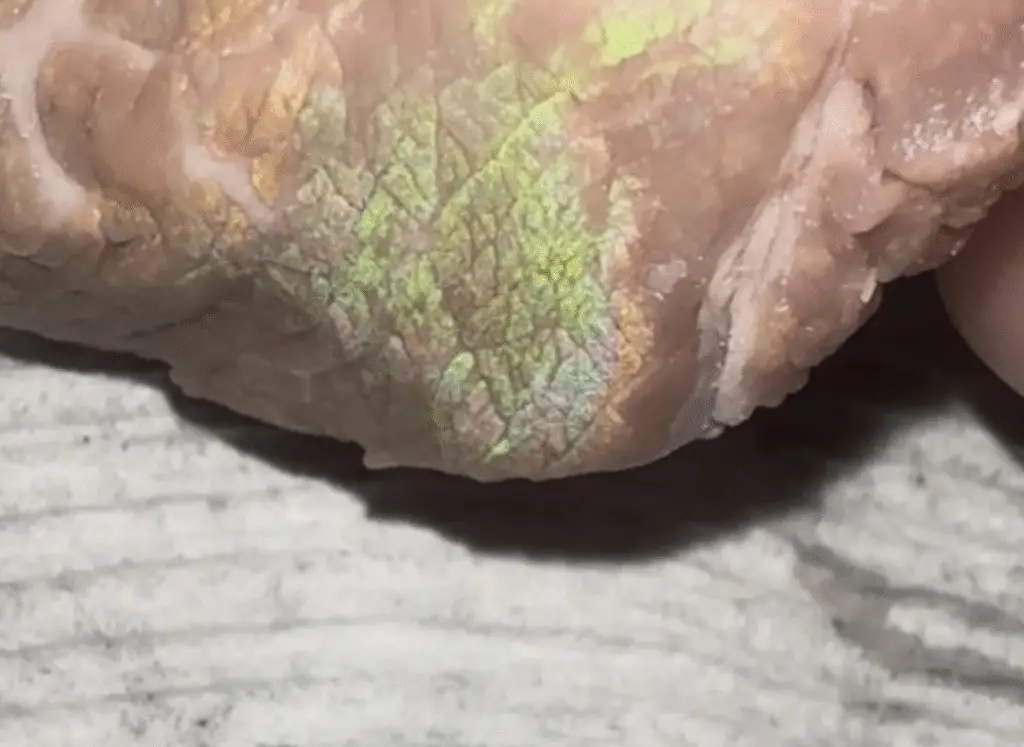
You open the fridge, pull out a slice of roast beef, and suddenly pause. Across the surface shimmers a faint rainbow—greens, golds, even hints of purple—almost like oil on water. It looks unusual, maybe even alarming. Your first thought is spoilage. Your second thought is whether it’s still safe to eat.
Take a breath. That rainbow sheen is not a warning sign. It has nothing to do with rot, bacteria, or food dyes. What you’re seeing is a harmless optical effect rooted in physics, not food safety.
Once you understand what’s happening, it becomes less unsettling and more fascinating.
The Science Behind the Rainbow Effect
Meat as a natural light reflector
Meat is not smooth at the microscopic level. Whole cuts of meat are made up of long, tightly packed muscle fibers that run in parallel lines. When deli meats like roast beef, corned beef, or pastrami are sliced cleanly across those fibers, the cut surface develops tiny, uniform ridges.
When light hits these ridges, it does something interesting. Instead of reflecting straight back, the light bends and separates into different wavelengths. Each wavelength corresponds to a different color. Your eyes then pick up these colors as a shifting, rainbow-like sheen.
This process is called structural coloration. It has nothing to do with pigments or additives. It is simply light interacting with structure.
The same effect seen in nature and technology
This phenomenon appears all around us, even if we do not always notice it. The shimmering colors of peacock feathers come from microscopic structures, not dyes. Butterfly wings glow for the same reason. CDs and DVDs display rainbow patterns because their surfaces split light into separate wavelengths.
Meat, when sliced just right, behaves in a surprisingly similar way.
Why Only Certain Meats Show Iridescence
Whole-muscle cuts are most affected
Rainbow coloring appears most often on meats that come from a single muscle and are sliced thinly. Roast beef, corned beef, pastrami, and some hams fall into this category. These meats retain the natural alignment of muscle fibers, which allows light to refract evenly.
In contrast, ground meats like hamburger or sausage rarely show this effect. Their fibers are mixed and disrupted, preventing the organized reflection of light.
Darker meats show it more clearly
Beef and other darker meats tend to display iridescence more dramatically. The deep red or brown background makes the reflected colors easier to see. Lighter meats like turkey or chicken can still show the effect, but it is usually faint and easy to miss.
The angle and lighting matter
The rainbow often disappears when you change your viewing angle or move the meat under different lighting. That shifting quality is another clue that the effect is optical rather than chemical.
Is Rainbow-Colored Meat Safe to Eat?
Yes, if other spoilage signs are absent
Iridescence alone does not indicate that meat has gone bad. It does not signal bacterial growth, chemical contamination, or unsafe storage. Shiny meat can be perfectly fresh, while dull meat can still be spoiled.
What actually matters are the usual warning signs. If the meat smells sour or rotten, feels slimy, or shows fuzzy mold, it should be discarded. If it smells normal, feels firm, and is within its use-by date, the rainbow sheen is harmless.
No link to additives or preservatives
Many people assume the color comes from dyes or chemicals. In reality, the effect appears just as easily in freshly sliced meat from a butcher counter as it does in packaged deli meat. It comes from the physical structure of muscle, not from processing.
Can You Prevent or Reduce the Rainbow Look?
Storage and presentation tips
While you cannot completely prevent iridescence, you can make it less noticeable. Storing meat in opaque containers limits light exposure. Keeping slices tightly wrapped reduces surface changes that can enhance the effect. Serving meat on darker plates can also make the colors less obvious.
That said, there is no need to hide it. The shimmer does not affect taste, texture, or safety in any way.
A Small Reminder of How Food Really Works
In an age of heavily processed foods and artificial coloring, rainbow meat can feel unsettling because it looks unexpected. Yet it is actually a sign of minimal processing and precise slicing. The effect highlights the natural structure of muscle and the way light interacts with it.
Rather than signaling danger, it quietly reflects the elegance of basic physics at work in everyday life.
So the next time your roast beef flashes a hint of green or gold, do not panic. It is not spoiled. It is not contaminated. It is simply light bending across the surface of your food, reminding you that even the most ordinary things can hold a bit of wonder.


Leave a Reply