
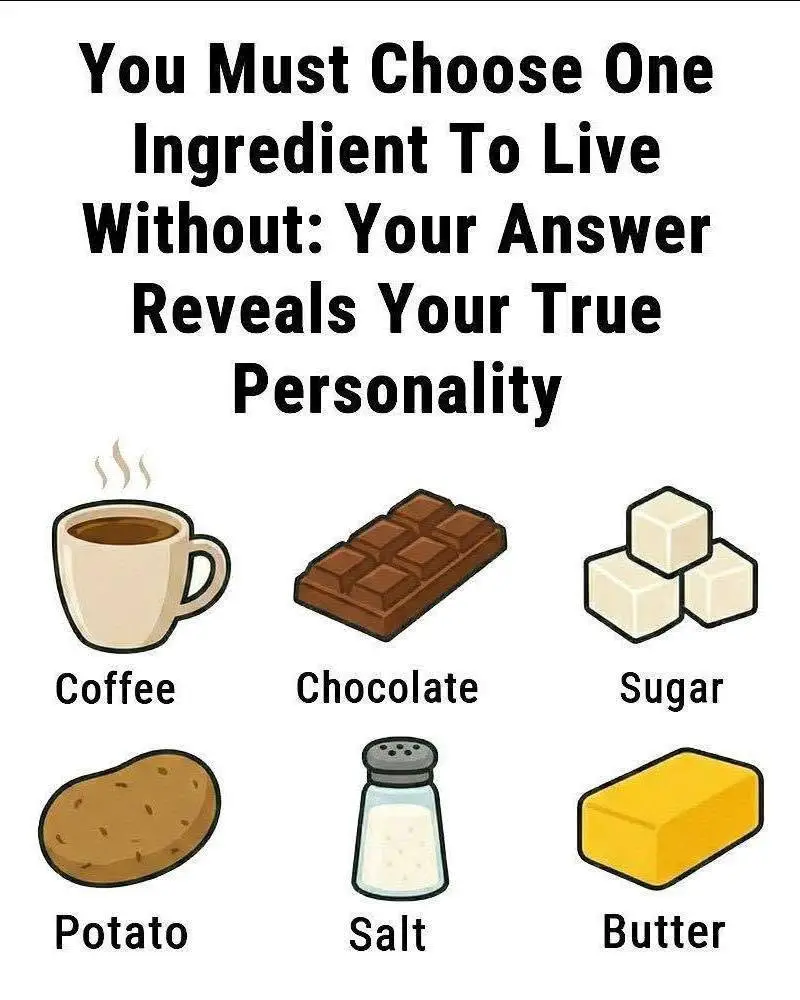
Social media is full of fun personality quizzes that promise to reveal hidden truths about who we are. One of the most popular examples asks a simple question:
If you had to live without one ingredient forever, which would you choose?
The choices usually include coffee, chocolate, sugar, potatoes, salt, or butter. At first glance, it seems like a harmless food preference question. However, many versions of the quiz go much further, claiming that your answer reveals your personality, emotional traits, relationship style, intelligence, or even your future success.
But is there any truth behind these claims?
The short answer is no.
While your food choices can reveal certain preferences and habits, there is no scientific evidence showing that choosing to give up coffee instead of chocolate can accurately determine your personality. Still, these quizzes remain incredibly popular because they tap into something that humans naturally enjoy: finding meaning in everyday decisions.
Let’s explore what you’re actually doing when you choose an ingredient, why these quizzes feel so accurate, and what your answer might realistically reflect.
Why Ingredient Quizzes Are So Popular
People love personality quizzes because they offer quick insights into who they are. In a world filled with complicated decisions and endless information, a simple question can feel surprisingly satisfying.
When someone asks you to choose one ingredient to live without, your brain immediately begins comparing options. You think about your favorite meals, your daily habits, and the foods you enjoy most.
Without realizing it, you’re performing a rapid evaluation process.
Questions begin running through your mind:
- How often do I drink coffee?
- Could I survive without chocolate?
- What would happen if I never used salt again?
- Which ingredient affects my daily life the least?
The process feels personal because it is personal. You’re drawing from your own experiences, memories, and preferences.
However, that doesn’t mean the choice reveals deep psychological truths.
Instead, it reveals something much simpler.
What You’re Actually Doing When You Choose
When faced with the ingredient challenge, most people evaluate three main factors:
1. Personal Enjoyment
The first thing many people consider is how much pleasure they get from each ingredient.
Someone who drinks coffee every morning may find eliminating coffee unthinkable.
A chocolate lover might instantly reject the idea of giving up chocolate.
This doesn’t reveal personality traits. It simply reflects enjoyment levels.
2. Daily Dependence
Some ingredients play a bigger role in everyday routines than others.
Coffee often becomes part of a morning ritual.
Salt appears in countless meals.
Butter is used in cooking, baking, and spreading.
People naturally hesitate to remove ingredients they use regularly.
Again, this reflects habits rather than personality.
3. Perceived Importance
Many people choose based on which ingredient seems least essential.
For example:
- Chocolate may feel like a luxury.
- Potatoes may seem replaceable.
- Sugar might appear easy to reduce.
This decision reflects practical thinking more than psychological traits.
The Psychology Behind Personality Quiz Claims
If these quizzes aren’t scientifically valid, why do they feel so convincing?
The answer lies in several well-known psychological effects.
The Barnum Effect
One of the strongest explanations is something psychologists call the Barnum Effect.
This occurs when people accept vague, general statements as highly accurate descriptions of themselves.
For example:
- You care deeply about others.
- You value honesty.
- You sometimes need time alone.
- You can be outgoing but also enjoy quiet moments.
Almost everyone can relate to these statements.
Yet when they appear as quiz results, they feel surprisingly personal.
That’s because our brains naturally focus on the parts that fit us while ignoring the parts that don’t.
Confirmation Bias
Another factor is confirmation bias.
People tend to notice information that supports their existing beliefs.
Suppose a quiz says:
“You are independent and strong-minded.”
If you already see yourself that way, you’ll likely agree immediately.
Meanwhile, you may overlook details that don’t match your experience.
This makes quiz results seem more accurate than they actually are.
The Desire for Self-Discovery
Humans naturally want to understand themselves.
We enjoy exploring questions like:
- Who am I?
- Why do I make certain decisions?
- What makes me different from others?
Personality quizzes provide simple answers to complex questions.
Even when the science is weak, the experience remains enjoyable.
What Each Ingredient Choice Might Realistically Reflect
Although ingredient choices don’t reveal personality traits, they can offer clues about food preferences and lifestyle habits.
Let’s look at each option.
Coffee
People who choose to eliminate coffee often fall into one of two groups.
The first group simply doesn’t drink coffee regularly.
The second group may enjoy coffee but believe they could function without it.
Choosing coffee doesn’t mean you’re calm, emotional, ambitious, or creative.
More realistically, it may indicate that caffeine isn’t a major part of your daily routine.
Chocolate
Chocolate is often associated with pleasure and indulgence.
Someone willing to eliminate chocolate may simply prefer savory foods over sweet ones.
Many people enjoy chocolate occasionally but don’t consider it essential.
Giving it up says more about your dessert preferences than your personality.
Sugar
People frequently select sugar because they associate it with unhealthy eating.
Some may already be trying to reduce sugar consumption.
Others may feel they can satisfy sweet cravings through fruit or alternative sweeteners.
This choice may reflect health awareness or dietary habits rather than character traits.
Potato
Potatoes appear in countless forms:
- French fries
- Mashed potatoes
- Baked potatoes
- Potato chips
- Hash browns
Yet many people choose potatoes because other carbohydrate sources remain available.
Rice, pasta, bread, and grains can often replace potatoes.
This choice may reflect flexibility in eating habits rather than any personality characteristic.
Salt
Salt presents an interesting case.
Many people initially choose salt because it doesn’t seem exciting compared to chocolate or coffee.
However, once they think about it, they realize how important salt is in cooking.
Salt enhances flavor in countless dishes.
Completely removing salt would dramatically change how many foods taste.
People who avoid choosing salt often recognize its culinary importance.
Butter
Butter contributes richness, texture, and flavor.
People who choose butter may already use alternative fats such as olive oil or vegetable oils.
Others may simply feel butter is easier to replace than coffee or chocolate.
Again, the choice reflects cooking preferences more than personal identity.
Why Food Choices Feel So Personal
Food is deeply connected to our lives.
Unlike many everyday products, food interacts with culture, family traditions, celebrations, and memories.
A simple ingredient can carry emotional significance.
For example:
- Coffee may remind someone of peaceful mornings.
- Chocolate may evoke childhood memories.
- Potatoes may connect to family recipes.
- Butter may represent comfort foods.
Because food carries emotional meaning, ingredient choices naturally feel personal.
That emotional connection can make personality quiz results seem more believable.
However, emotional significance and scientific personality assessment are two very different things.
What Science Actually Says About Personality
Psychologists have spent decades studying personality.
Modern personality research relies on extensive testing, statistical analysis, and long-term observation.
One widely accepted framework is known as the Big Five personality model.
This model examines traits such as:
- Openness
- Conscientiousness
- Extraversion
- Agreeableness
- Neuroticism
Researchers use carefully designed assessments to measure these characteristics.
Importantly, personality scientists do not determine traits by asking people which ingredient they would eliminate from their diet.
Human personality is far more complex than a single food preference.
A person’s character develops through:
- Genetics
- Life experiences
- Environment
- Education
- Relationships
- Cultural influences
No simple ingredient choice can capture all of these factors.
The Entertainment Value of These Quizzes
Even though they aren’t scientifically valid, ingredient quizzes aren’t necessarily harmful.
In fact, many people enjoy them for several positive reasons.
They Start Conversations
A simple ingredient question can quickly spark discussion among friends and family.
People enjoy explaining their choices.
The debate often becomes more entertaining than the quiz itself.
They Encourage Reflection
While the results may lack scientific support, the decision process encourages people to think about their habits and preferences.
You may learn something about your eating patterns.
You might realize how much you rely on coffee or how often you cook with butter.
They Create Social Engagement
Social media thrives on participation.
Questions with simple choices encourage comments, shares, and discussions.
The more relatable the question, the more engagement it generates.
Ingredient quizzes succeed because nearly everyone has an opinion.
Common Misconceptions About Personality Quizzes
Several myths help keep these quizzes popular.
Myth 1: Small Choices Reveal Deep Secrets
Reality: Most everyday choices reveal immediate preferences rather than hidden psychological truths.
Myth 2: Everyone Gets a Unique Result
Reality: Many quiz outcomes use broad descriptions that apply to large numbers of people.
Myth 3: Quiz Results Are Scientifically Tested
Reality: Most viral social media quizzes have no scientific foundation.
Myth 4: Food Preferences Define Personality
Reality: Food preferences reflect taste, culture, experience, and habits more than personality traits.
A More Meaningful Way to Interpret Your Answer
Instead of viewing your choice as a personality diagnosis, consider it a reflection of your relationship with food.
Ask yourself:
- Which ingredient do I use most often?
- Which foods bring me comfort?
- What flavors do I enjoy most?
- Which ingredient feels easiest to replace?
These questions can provide genuine insight into your habits.
The answers may reveal:
- Dietary patterns
- Cooking preferences
- Cultural influences
- Lifestyle choices
Those insights are far more realistic than claims about hidden personality traits.
The Real Lesson Behind the Quiz
The ingredient challenge highlights something interesting about human behavior.
People naturally seek meaning in everyday choices.
We enjoy connecting simple decisions to larger narratives about who we are.
That tendency isn’t necessarily wrong.
In fact, it reflects our desire for self-understanding.
The problem only arises when entertainment is mistaken for science.
A quiz can be fun without being factual.
You can enjoy discussing whether you’d give up coffee, chocolate, sugar, potatoes, salt, or butter while recognizing that the answer doesn’t determine your character.
Final Thoughts
Choosing one ingredient to live without does not reveal your true personality.
It does not measure intelligence, kindness, honesty, ambition, emotional depth, or relationship potential.
What it may reveal is something much simpler:
- Your food preferences
- Your cooking habits
- Your daily routines
- Your cultural influences
- Your current priorities
The next time you encounter one of these viral ingredient quizzes, enjoy it for what it is—a fun conversation starter.
If you choose coffee, chocolate, sugar, potatoes, salt, or butter, you’re not uncovering a hidden psychological profile.
You’re simply making a decision based on taste, habit, convenience, and personal experience.
And that’s perfectly interesting on its own.




Leave a Reply